|
2011 - 2019
Monthly Letters from George
Auto-Free NY was founded in February 1989. Since January, 2002, Auto-Free NY's website has presented a monthly letter from its chairman and founder, George Haikalis, introducing each monthly meeting's theme. New Yorkers concerned with getting NYC to confront its backwardness in addressing its chronic car-caused traffic problems would do well to review this archive of George's letters, special guests and meeting subjects, arranged here in reverse chronological order.
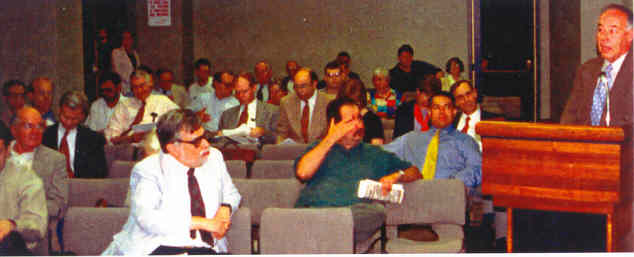
George (seated, front row) attends an MTA Lower Manhattan Access public hearing, circa 2002.
March 2020:
AFNY meetings have been suspended until further notice!
February 2020: Meet & Greet with the new Executive Director of Transportation Alternatives!
Speaker: Danny Harris, executive director, Transportation Alternatives
Our February vision42/regional rail/Auto-Free NY working group meeting, at the T.A. Conference Room, 111 John Street, was a chance to get acquainted with Danny Harris, the dynamic new executive director of Transportation Alternatives. IRUM and T.A. have much in common, and this will be a sterling opportunity to discuss goals and objectives and productive next steps for our longstanding collaborative efforts. Our monthly IRUM Working Group meetings first began as the "Auto-Free New York committee of T.A." back in 1990 - thirty years ago! This working group eventually became a unit of the Institute for Rational Urban Mobility (IRUM) in 1997.
The working group then continued our discussion of several initiatives we touched on in the past few months including:
1. free public transit for the NY-NJ-CT region
2. productive reduction of unsustainable highway capacity
3. making better use of the region's disconnected commuter rail lines.
Finally, we reviewed opportunities for advancing vision42 - an auto-free light rail boulevard on 42nd Street - through an Earth Day carfree initiative in April and also by working closely with advocates for the Brooklyn-Queens waterfront light rail line - see details of the proposal at http://www.bqx.nyc/
December 2019: KANSAS CITY: FREE PUBLIC TRANSIT WILL BE FIRST IN THE NATION
Speaker: Jeff Gold, IRUM Vice President
Our vision42/regional rail/Auto-Free NY working group meeting on December 17 featured guest speaker, longtime IRUM vice president Jeff Gold who gave a brief update "Everything's Up to Date in Kansas City" - in particular that city's public transit system, which will become the first major US city to establish free public transit beginning at the first of the year. Jeff also described IRUM's study of free transit completed in January 2008 which can be found at:
https://www.irum.org/20080123%20-%20Kheel_Report.pdf
Interest is also growing globally, in other cities more sophisticated than New York, such as Toronto and Paris, for fare-free transit. Here in NYC, of course, the Staten Island Ferry has been free since July 1997. Tuesday's meeting included a lively discussion of proposals for free transit in NYC and for the entire metropolitan area.
The meeting also reviewed progress on IRUM's longstanding two major initiatives:
- Gaining support for vision 42- an auto-free light rail boulevard on 42nd Street; and
- Remaking the region's three commuter rail lines into a Regional Rail System with frequent service, integrated fares, and thru-running, initially at Penn Station and then linking Penn Station with Grand Central.
November 2019: THE MTA's and NJ Transit's INVESTMENT PLANS FOR REGIONAL RAIL: HEADED IN THE RIGHT DIRECTION?
Speaker: NIck Sifuentes, executive director, Tri-State Transportation Campaign
Our November AFNY/vision42 meeting, our guest speaker was Nick Sifuentes, executive director of the Tri-State Transportation Campaign. His presentation was: "Are NJ Transit and MTA investment plans for regional rail heading in the right direction?"
Nick has been with the Tri-State Campaign for a little over two years. The Campaign fights for an equitable, safe, multi-modal transportation network that provides options and supports the economies of NY, NJ, and CT.
The meeting also included progress reports on IRUM's two major initiatives:
- Gaining support for vision 42- an auto-free light rail boulevard on 42nd Street; and
- Remaking the region's three commuter rail lines into a Regional Rail System with frequent service, integrated fares, and thru-running, initially at Penn Station and then linking Penn Station with Grand Central.
September 2019: AUTO-FREE PLANS FOR THE COMING YEAR, 2019-2020
George wrote: "We hope everyone had an enjoyable summer. We had two interesting walking tours, instead of regular monthly meetings, one in New Rochelle and the other in Jackson Heights, which started at its new and very popular pedestrian plaza in and around the bustling subway/elevated station at Roosevelt Avenue.
At our September meeting, back in the TA offices, we briefly summarized the tours and other working group events that took place this summer, but most of the meeting was devoted to outlining plans for the working group for the coming year.
Key issues:
** Celebration of NYC's congestion pricing - now what?
** Towards a comprehensive street use plan for the Manhattan CBD beginning with vision42, an auto-free light rail boulevard on 42nd Street, and
** Remaking the region's three commuter rail lines into a Regional Rail System with frequent service, integrated fares, thru-running, initially at Penn Station and then linking Penn Station with Grand Central."
August 2019: OUR SUMMER WALKING TOUR #2: JACKSON HEIGHTS
Tour Guides: Ed Walters
Our August vision42/regional rail/Auto-Free NY working group walking tour was in Jackson Heights, Queens, guided by long term working group member and Jackson Heights resident, Ed Walters. The tour headed west from the Roosevelt Avenue subway station main lobby on Roosevelt Avenue and walked to the bridge over the BQE, for a quick glimpse at the little-used Bay Ridge-Hell Gate freight line, now overgrown with mature trees but still featuring working railroad tracks. For many years rail advocates have called for adding light rail passenger service on this line - a rare existing urban right-of-way - to serve as a circumferential connector that would link many of the region's mostly radial transit lines, like a much bigger version of the G subway train.
One remarkable proposal for this route, called the Brooklyn-Queens Rail Link, had been prepared in 1994 in a 38-page illustrated report, by AFNY participant Wayne Fields for the Committee for Better Transit, and can be downloaded free here (as a 2.6MB pdf):
https://www.irum.org/199406_CBT_BQ_RailLink_report.pdf
The walking tour then returned to the pedestrian plaza at the subway station, gathered the stragglers, and then walked to two recently upgraded auto-free street segments in Jackson Heights: Diversity Plaza and the newly completed 78th Street Pedestrian Plaza, which links Travers Park and Rory Staunton Field. For more info about these auto-free enclaves see:
http://hiddengems.nycitynewsservice.com/2017/12/01/plaza/
https://www.nycgovparks.org/planning-and-building/capital-project-tracker/project/6276.
https://nyc.streetsblog.org/2019/05/11/cm-dromm-abandoning-jackson-heights-street-plan-is-abandoning-vision-zero/
NYC City Council member Danny Dromm (District 25) has long advocated for the creation of these auto-free spaces in his district. [The tour, behind schedule, skipped heading north to view automobile hellscape Northern Boulevard. This residential highway has been dubbed Queens' second "Boulevard of Death", after Queens Boulevard was "calmed" - activists had fought for decades to get Queens Boulevard re-designed to cut down on the death toll of pedestrians and cyclists due to high-speed car traffic.]
Tour leader Edward Walters invited the group to rest at the end of the tour in the garden of the Fillmore East in the Jackson Heights historic district where he lives, and to enjoy a post-tour beverage.
Also, the Astor Place Festival hosted by the Village Crosstown Trolley Coalition was held on Saturday, August 24. 2019, 10am-6pm. For more info on VCTC and its plan for an auto-free 8th St-Christopher-St. Marks Place light rail see:
https://www.villagetrolley.org/
July 2019: OUR SUMMER WALKING TOUR #1: NEW ROCHELLE DOWNTOWN
Tour Guides: Nina Aaron and Frank Buddinghtree
Our July vision42/regional rail/Auto-Free NY working group event wasa guided walking tour of Downtown New Rochelle, on Tuesday July 16, 2019, led by two urban planners who often attend our monthly AFNY meetings: Nina Aaron and Frank Buddinghtree.
After gathering in the station, we will be briefed by Nina and Frank (the two live in New Rochelle, and are local advocates for "Strong Towns"), the walking tour will visit downtown New Rochelle.
Tour participants should buy a one-way ticket at Grand Central for New Rochelle. Board the 6:02pm train for New Rochelle and ride in the last car. After arriving at New Rochelle, tour participants should assemble on the Manhattan-bound platform. Most likely that means they will have to cross over using the overpass (elevator available).
The one-way Metro-North ticket (peak fare) is $11.25; the (off-peak) return trip ticket, which can be purchased at the New Rochelle station, will cost $8.25. (A far less costly, but considerably slower option would be to take Westchester County’s BeeLine Bus #60 or #61 from the Pelham Parkway subway station on the #2 subway in the Bronx. The bus accepts MetroCards. Check their website for maps and schedules).
Though we are still celebrating the recent agreement toward a "cordon toll" for vehicles entering the Manhattan Central Business District (CBD) - to reduce motor vehicular traffic in the crowded core of NYC - there are still a lot of details to be worked out. We hope to have a brief “status report” on that initiative at next Tuesday’s gathering.
June 2019: The New Congestion Pricing Plan, Part III: Status Report
Moderator: George Haikalis
Our next vision42/regional rail/Auto-Free NY working group meeting was on Tuesday, June 18, 2019, 6-8pm, at the offices of Transportation Alternatives. Though we are still celebrating the recent agreement toward a "cordon toll" for vehicles entering the Manhattan Central Business District (CBD) - to reduce motor vehicular traffic in the crowded core of NYC, there are still a lot of details to be worked out. We hope to have a brief "status report" on that initiative at next Tuesday's meeting.
Two of IRUM's long standing proposals: (1) to make better use of the region's sleeping giant of enhanced mobility - its three commuter rail lines - and (2) to create a grid of auto-free light rail boulevards in the crowded core of the city, fit neatly with the Manhattan CBD cordon toll plan. The challenge for our working group is to articulate these proposals into an appealing plan that can gain widespread public support. This will be discussed at Tuesday's meeting as well.
The two acting co-directors for TA, Ellen McDermott and Marco Connor, were invited to speak at our meeting about opportunities for collaboration regarding the Congestion Pricing Plan, and our longstanding 4-Year Plan.
Please visit WWW.IRUM.ORG for our latest documents and pdfs regarding auto-free and transit issues in NYC!
Also not to be missed is a reception for the Brooklyn-Queens Light Rail plan (BQX), to be held on Wednesday, June 26th at The Brazen Head Pub, 228 Atlantic Avenue, Brooklyn (1/2 block east of Court Street), from 6-8pm. RSVP is recommended to George at the address below. See the Friends of the Brooklyn Queens Connector website: http://WWW.BQX.NYC.
May 2019: New York's Congestion Pricing Plan, Part II
Moderator: George Haikalis
Our May 21st vision42/regional rail/Auto-Free NY working group meeting was held at the offices of Transportation Alternatives. In April, we celebrated the agreement that the Mayor, the Governor and the NY State Legislature made to establish a 'cordon toll' for vehicles entering the Manhattan Central Business District (CBD) - to reduce motor vehicular traffic in the crowded core of NYC. Revenues generated from this 'congestion pricing' plan would be used to fund much-needed improvements to the region's bus and rail systems.
But now what?
Still missing is a comprehensive plan for funding the capital and operating costs of an improved public transit system. Two of IRUM's long standing proposals: (1) to make better use of the region's sleeping giant of metropolitan mobility - its three commuter rail lines - and (2) to create a grid of auto-free light rail boulevards in the crowded core of the city - dovetail neatly with the Manhattan CBD cordon toll plan. The challenge for our working group is to articulate these proposals into an appealing plan that can gain widespread public support.
Two key IRUM.org presentations (below) are highly recommended reading for this topic - they are posted on IRUM's website, one given to the Planning Department at the Port Authority and the other given to the Manhattan Borough President:
https://www.irum.org/20190115_Why_PA_Should_Support_Regional_Rail.pdf
https://www.irum.org/20190319_Statement_MBP_Brewer_Hearing_on_Manhattan_Congestion.pdf
We also reviewed NYC Council Speaker Corey Johnson's recent proposal for improving transportation in the city:
https://council.nyc.gov/news/2019/03/05/soc2019-report/
Also not to be missed - mark your calendar!:
Rally for Brooklyn-Queens waterfront light rail plan (BQX) at City Hall, May 30, 2019 10am.
April 2019: New York's Congestion Pricing Plan Approved!
Speaker: Tom DeVito, director of advocacy at Transportation Alternatives
It's time to celebrate! Mayor DeBlasio, Governor Andrew "Amazon" Cuomo and the NY State Legislature have all agreed to establish a cordon toll for vehicles entering the Manhattan Central Business District (CBD), to reduce motor vehicular traffic in the crowded core of NYC. Revenues generated from this congestion pricing plan would be used to fund much-needed improvements to the region's bus and rail systems.
IRUM and many other advocacy organizations worked together to gain the support needed to make this happen. See IRUM's most recent statement on the www.irum.org website:
https://www.irum.org/20190319_Statement_MBP_Brewer_Hearing_on_Manhattan_Congestion.pdf
Many thanks to all who helped move this forward!
The April 2019 meeting was also promised a brief summary by Thomas DeVito, the director of advocacy for Transportation Alternatives, of the citizens' role in gaining support for Congestion Pricing. Tom was to outline the next steps that will be needed to make this a reality.
The meeting will also include progress reports on two key IRUM initiatives:
(1) - vision42 - an auto-free light rail boulevard for 42nd street; and
(2) - remaking the region's three commuter rail lines into a coordinated regional rail system.
March 2019: Replacing the Grand Hyatt: What's Best for Grand Central Station?
Speaker: John West, architect and urban planner, and IRUM board member
Our March 19, 2019 vision42/regional rail/Auto-Free NY working group meeting was held at the T.A. offices. The discussion was about "Making Grand Central even more Grand" (goodbye cheesy Grand Hyatt Hotel, hello - - what?). IRUM's board member John West made a presentation about reworking the site of the hotel as part of a new development that would greatly improve access to the overcrowded Lexington Avenue subway station that lies just below the hotel.
Two other key IRUM initiatives that have long been proposed were discussed:
(1) vision42 - a plan for closing 42nd Street to traffic, adding much needed pedestrian space and a crosstown river-to-river light rail line on 42nd street;
(2) connecting Penn Station with Grand Central Terminal with regional rail, permitting west-of-Hudson commuters a direct one-seat ride to this massive East Midtown development, reducing the load on crowded subways, platforms and stairways.
Finally, we are expecting at our meeting a transportation planner from City Council Speaker Corey Johnson's office to describe for us the Speaker's plan to give NYC more control of its subways and buses. [Corey Johnson's Council page]
Councilman Johnson's highly recommended full 101-page report is available as a free pdf download on the council.nyc.gov website (pages 7-10 contain a concise summary):
https://council.nyc.gov/news/2019/03/05/soc2019-report/
February 2019:
January 2019: The "Amazoning" of Queens, Part II: Other Strategies for the Area
Speaker: John West, architect and urban planner, and IRUM board member
Our next vision42/regional rail/Auto-Free NY working group meeting will be held on Tuesday, January 15, 2019, at the offices of T.A. The meeting continued the lively discussion begun at our December meeting on transportation issues relating to the currently dreary, pedestrian-unfriendly and auto-dominated Long Island City business district. While some NYC activists are focusing on Amazon's apparent anti-labor practices, anti-small-business monopoly push, a helipad for trillionaire Jeff Bezos, and the company's anti-democratic negotiating tactics, our discussion will go beyond the concerns raised at our last meeting on the extraordinary potential transport impacts of Amazon HQ. We will discuss a wide array of opportunities for remaking the LIC business district into a showcase of sustainable urban development.
We'll look at strategies for the Sunnyside Yards development, in particular, plans for an on-line Sunnyside intermodal regional rail station serving LIRR, Metro-North and NJ Transit. One proposal would greatly reduce the existing necessity for massive mid-day rail car storage in the Yard, by thru-running regional rail trains and operating more frequent service.
Other LIC issues - local light rail transit circulation, traffic mitigation impacts of congestion pricing such as bridge tolls, and Auto-Free NY's longstanding proposal to dramatically redesign the Queensboro Bridge's vehicular usage, will be examined. AFNY has suggested remaking the bridge's upper deck as an auto-free pedestrian/bike promenade, while restoring light rail service on the bridge's outer roadways.
Your Auto-Free chair will attempt to stir this brew. This will be an interesting and informative presentation that you won't want to miss!
December 2018: Amazon HQ and Long Island City's Transportation Issues, Part I
Speaker: John West, architect and urban planner, and IRUM board member
Our December 18, 2018, 6-8pm meeting, at the offices of Transportation Alternatives, focused on transportation issues relating to the Long Island City business district, which has become the center of considerable attention with Amazon's decision to build its new (half) headquarters there. IRUM Board Member John West, an architect and urban planner with a long-standing appreciation of real estate issues about this business district, led the discussion. He showed a presentation that he prepared that describes the many potential transportation opportunities for improving access to this already congested hub, so near to midtown and yet so far.
November 2018: New Thinking for Regional Rail in the Boston Area
Speaker: Peter Brassard, architect and planner
Our November vision42, regional rail and Auto-Free NY working group meeting featured special guest speaker, architect and planner Peter Brassard, who prepared an illustrated presentation, "A plan for Regional Rail for the Boston area - Bus, Rail, and the Future of Regional Mobility". This is quite an interesting and informative presentation that you won’t want to miss! The meeting also included progress reports on three key IRUM initiatives:
- vision42 - an auto-free light rail boulevard for 42nd street;
- remaking the region’s three commuter rail lines into a coordinated regional rail system with integrated fares, frequent service and through running, first at Penn Station and then by connecting Penn Station with Grand Central Terminal;
- IRUM’s efforts to advance carrot-and-stick measures to reduce car use in the core of the city.
On Monday, November 12th, George Haikalis was one of the speakers at a standing-room-only panel discussion on the Gateway Tunnel, "The Trunk Line: The Future Beyond the Gateway Tunnel". [The representative from the Port Authority had to duck out early, allegedly because of severe commuter rail delays that evening!] The discussion, sponsored by the NY Chapter of the AIA, and was held at the Architecture Center, 536 LaGuardia Place, in Greenwich Village, and was similar to one sponsored by the City Club of New York last spring at Hunter College.
http://calendar.aiany.org/2018/08/23/the-trunk-line-the-future-beyond-the-gateway-tunnel/
October 2018: The Future of Mobility: the Tri-State Transportation Campaign's Views
Speaker: Liam Blank, TSTC advocacy/policy manager
At our October 16th Auto-Free meeting, held at the Transportation Alternatives offices in Lower Manhattan, our special guest speaker, Liam Blank, Advocacy and Policy Manager for the Tri-State Transportation Campaign, presented "Bus, Rail, and The Future of Regional Mobility."
The Tri-State Transportation Campaign is a NYC-based non-profit dedicated to mobility, accessibility and livability in NY, NJ and CT. It uses data and policy analysis, along with strategic media outreach, to influence decision-making throughout the metropolitan region. Since it was founded in 1993, the TSTC has become a leading voice in the region for transportation and land use policy reform, and has enjoyed a strong record of accomplishment.
The meeting also included progress reports on key IRUM initiatives including vision42 - an auto-free light rail boulevard for 42nd street, remaking the region's three commuter rail lines into a coordinated regional rail system with integrated fares, frequent service and through running, first at Penn Station and then by connecting Penn Station with Grand Central Terminal and IRUM's efforts to advance carrot-and-stick measures to reduce car use in the core of the city.
August 2018: Our Summer Walking Tour #2: the Queens Proposed AirTrain Route near Flushing Meadows Corona Park
Governor Cuomo's proposed LaGuardia "Air-Train" shuttle link, to and from the Mets-Willets Point Subway and LIRR stations in Queens, has drawn considerable attention and debate. Plan to join us for our 2018 August Walking Tour of these two stations and the adjacent Flushing Meadows Corona Park on Tuesday, August 21, 2018, beginning at 6pm. We will meet in front of the subway token booth, just outside the 24-hour paid area of the subway station. The tour will be led by Michael Anderson, a nearby resident, who is a Corona Park/World's Fair aficionado and marathon runner.
For those non-marathon runners, not to worry! The roughly two-mile tour will take place at a comfortable walking pace!
IRUM, established in 1989, has long supported proposals for auto-free zones in NYC. Two outstanding examples were located in Flushing Meadow Park, when the World's Fairs of 1939 and 1964-65 were designed around ceremonial pedestrian paths, with automobiles consigned to the periphery. The exceptions were those cars exhibited in auto-manufacturers' buildings. Both fairs included extensive rail facilities which encouraged car-free access to the exhibitions. Unfortunately, car hugging (and streetcar-line-killing) master builder Robert Moses, who promoted these fairs, used them as an excuse to launch extensive networks of express highways in Queens. While not all of the proposed highways were built, much damage was done and communities were split apart. The Park itself, however, remains as one of his legacies and the walking tour will cover a few highlights.
 July 2018: Our Summer Walking Tour #1: the Newark Light Rail System
Our July Summer Walking Tour ventured across the Hudson River "ocean" to visit Newark's storied light rail line! Light rail has long been a key element in Newark's surface transit system. Its 'City Subway' was the trunk line for a once extensive network of light rail in northern NJ. Most of this network was abandoned in the auto-dominated postwar era, but the 3.5-mile fully grade-separated City Subway survived. About two decades ago, light rail made a terrific comeback in NJ, with the construction of the 34-mile, 24-station Hudson-Bergen light rail line along the Hudson River waterfront (one of the prime movers in this new line's construction - the author James Greller - has promised to join us!). The latest section of this new line opened in January 2011, and more extensions are planned.
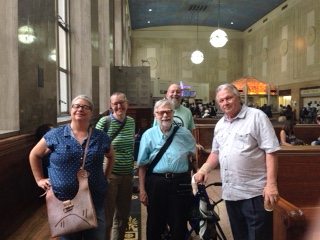
While motor vehicle interests were frantically dismantling NJ's network of trolley lines in the decades after WWII, Newark's City Subway soldiered on, and has in recent times been modernized and expanded. Many New Yorkers - and in particular, a good chunk of its politicians and newspaper editors - are amazingly uninformed about light rail transit, and we are always encouraging such folk to venture across the one-mile-wide Hudson "ocean" and see for themselves what light rail is actually like. Our Walking Tour of the the Newark trolley will begin promptly at 6pm, on Tuesday, July 17. Meet us at the information counter in the handsome Art Deco waiting room at Newark, Penn Station Newark (seen in pictures here, by Ed Walters). Participants coming from NYC can take NJ Transit or PATH trains to reach the station.
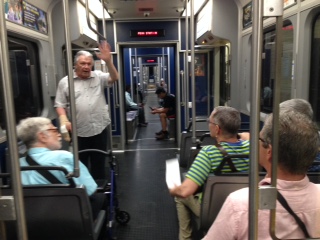 IRUM participants Ed Walters and Juan Llera will lead the tour. We will take the Broad Street station branch of the City Subway, which leaves from its underground terminal beneath the station. This branch serves the NJ Performing Arts Center, Newark Museum, the Public Library, the Riverfront Stadium and finally the refurbished Lackawanna station at Broad Street. Be aware that City Subway fare is $1.60 one way for one hour and 75 cents for seniors (age 62 and over) - fares are not included on this free tour! After the tour, those interested can join us for a bite to eat at a nearby pub.
IRUM has long supported light rail proposals for NYC, which can serve as combined 'carrot and stick' strategies, making dense neighborhoods more livable by introducing appealing surface transit options while reducing street space for free-wheeling motor vehicles, that would drastically improve everyone's quality of life.
June 2018: Moving Forward on the BQX Light Rail Line Proposed for the Brooklyn-Queens Waterfront
Speakers: Jessica Schumer and Jenna Bimbi, directors at Friends of the BQX
IRUM has long supported light rail lines for urban areas, including NYC. One such initiative is Mayor Bill de Blasio’s visionary plan for a $2.5 billion, 16-mile light rail line stretching along the East River waterfront from Astoria south to Sunset Park. This plan would greatly ease travel by public transit for some 600,000 residents living a considerable distance from existing subway lines.
Plan to attend our JUNE Auto-Free NY-vision42-regional rail working group meeting on Tuesday, June 19, 2018, when Jessica Schumer, executive director, and Jenna Bimbi, deputy director, of Friends of the BQX, will present "Moving forward on the BQX: the Brooklyn-Queens Connector - a waterfront light rail line."
Progress reports will also be presented at the meeting on other IRUM initiatives, including
- vision42: an auto free light rail boulevard for 42nd Street;
- remaking of the region’s three commuter rail lines into a coordinated Regional Rail System, with frequent service, integrated fares, and through-running, first at Penn Station and then, using a new link between Penn Station and Grand Central; and
- advancing more equitable pricing strategies for motorists and public transit users, while diminishing excessive car use in the crowded core of the city.
May 2018: We Must Connect Penn Station with Grand Central!
Special Guest: Ethan Finlan, freelance researcher and author, "Examining Commuting Patterns to the GCT/Penn Station Areas"
IRUM has long called for a rail link connecting Penn Station and Grand Central - "the mother of all train station connections" - and remaking the three commuter rail lines serving the NY-NJ-CT metropolitan area into a coordinated regional rail system, with frequent service, integrated fares and thru-running, first at Penn Station and then through the connection to Grand Central.
Plan to attend the next monthly auto-free New York/vision42/regional rail working group meeting on Tuesday, May 15, 2018, 6-8pm at the TA offices, where the discussion will center on this essential connection. Ethan Finlan, a Boston-based freelance researcher and writer focused on transportation planning issues, will present some interesting findings from his recent study "Examining Commuting Patterns to the Grand Central and Penn Station areas."
Also at the meeting, highlights of an April 20th panel hosted by the City Club of NY and moderated by former NY City Council member Dan Garodnick will also be summarized. The panel, organized by IRUM board member John West, was a lively debate among leading rail experts on three competing visions for a regional rail "trunk line" in the core of Manhattan.
The May 15th working group meeting will attempt to devise a credible strategy for moving forward on the connection, taking into consideration some of the findings presented by Mr. Finlan and the positions articulated at that City Club panel. Also, Roxanne Warren, chair of vision42, will walk us thru IRUM's most recent draft of a presentation that makes the case for this for an auto-free light rail boulevard, river-to-river on 42nd street. We will look forward to your comments and suggestions on how to sharpen this presentation.
As you may have noticed, these two IRUM initiatives intersect at 42nd Street and Park Avenue in Manhattan - the East-West crosstown light rail on the surface, and the regional rail tracks below ground from Penn Station approaching the lower level regional rail tracks at Grand Central. These critical initiatives will ease access and improve the walking environment in the very epicenter of East Midtown, the crowded hub that has been recently "upzoned" in order to shoehorn in another six million square feet of office space.
April 2018: Make 42nd Street Car-Free Every Day!
NYC Celebrates its Third Annual Car-Free Day, April 17th
It's time to make 42nd Street carfree everyday! At our April 17, 2018 monthly meeting, Roxanne Warren, architect and author and Chair of vision42, will lead a discussion on the key steps that are needed to make this happen. Even though Manhattan's 42nd Street is NYC's busiest crosstown thoroughfare, with pedestrians outnumbering motorists by a ratio of six-to-one, NYC's elected officials are reluctant to part with their cars.
One hopeful sign of positive change is NY City Council transportation committee chair Ydanis Rodriguez's efforts to call attention to the need to rid our city of its car-packed streets by celebrating NYC's third annual car-free day - on Saturday, April 21, 2018. Car Free Day will open two miles of streets to pedestrian and bicycle traffic only -- including Broadway from Union Square to Times Square and along St. Nicholas Avenue in Washington Heights.
Our April meeting will also feature progress reports on our efforts to advance congestion pricing in the Manhattan core by using carrot-and-stick pricing strategies, and to remake the region's three separate and disconnected commuter rail lines into a coordinated Regional Rail System - with frequent service, integrated fares and through running - first at Penn Station, and then with a new Hudson River rail tunnel and a "trunk line" that connects Hoboken Terminal with Penn Station and continues on to Grand Central. This would produce a world-class regional rail system that would rival systems already in place, or under construction, in London, Paris and other global centers.
Toward this end, our host nonprofit - the Institute for Rational Urban Mobility (IRUM) - is assisting the City Club of New York as it presents a panel on alternative futures for the region's rail trunk line. Former NY City Council member Dan Garodnick will moderate a discussion among leading rail experts on Friday, April 20, 2018 from 1-2:30pm at Hunter College. There's no charge for attendance. We wish that all of you could come, but, after seating Hunter students, we have limited remaining space. If you are interested, please RSVP right away at: http://cityclubny.org/evrplus_ registration/.
March 2018: One Region: A NYC Perspective on Metropolitan Growth
Speaker: Carolyn Grossman Meagher, Director of Regional Planning, NYC Dept of City Planning
Ever since the Tri-State Regional Planning Commission was dissolved in 1982, our 22-million-person NY-NJ-CT metropolitan area has stumbled along without any coherent regional planning entity. As the region's transport systems have experienced chronic severe congestion and crises, quality of life continues to suffer and indirect costs exact a heavy toll, it has become clear that the region needs to get its act together and chart a more sustainable future.
Fortunately, NYC - the core of the region and its largest city, has begun to realize that it must take the lead in showing the way to force the cooperation of the dozens of political entities and unelected authorities that determine our region's future. On Tuesday, March 20, 2018, 6-8pm, ar our AFNY - RR - vision42 monthly meeting, Carolyn Grossman Meagher, Director of Regional Planning, NYC Dept. of City Planning, will describe a vision to begin to accomplish this: "One Region: a NYC Perspective on Metropolitan Growth".
February 2018: The North American Light Rail Renaissance and its potential for NYC
Speaker: Andrew Bata, regional manager, UITP
IRUM has long championed adding light rail transit in the core of NYC as a unique "carrot-and-stick" strategy for reducing excessive car use in our crowded city. Not only does light rail offer an appealing way to travel ("the carrot"), it also reduces roadway space for motor vehicles in dense urban places (the "stick").
In 1978, a visionary NYC civic benefactor - Fred Papert - first called for a river-to-river crosstown trolley for 42nd Street as a way to restore a declining Midtown, particularly around Times Square, and to make surface transit more appealing while stimulating economic renewal. Papert's interest in light rail on city streets corresponded with a growing interest globally for this mostly abandoned mode of urban travel.
In the past three decades, dozens of new light rail lines have been successfully introduced in cities throughout the US, including one just across the river in New Jersey. Unfortunately, for decades, City Hall hunkered down, fearfully confusing the Hudson River with a Hudson Ocean. NYC has stubbornly resisted light rail advancement, and so the city's been everywhere stuck in the same old rut: buses trapped in traffic jams. Even where bus lanes and stops were added, parking restrictions are poorly enforced. And roadway surfaces are continuously disrupted for utility repairs buried beneath the pavement. Re-paving work is more often than not ham-fisted, resulting in a bumpy ride for buses, making navigating NYC's streets more challenging than in some third world countries.
Clearly light rail lines in dedicated lanes on the city's busiest transit arteries would set a new standard here for surface transit. Light rail offers a smooth, self-enforcing path providing the capacity needed in very dense urban settings.
Plan to attend our February auto-free NY / vision42 / regional rail working group meeting and find out how much of the world is leaving NYC and its pot-holed streets in the dust. Our special guest speaker will be Andrew Bata, regional manager for North America at the UITP (International Association of Public Transport). For more information about IRUM's effort to advance a light rail pedestrian boulevard on 42nd Street check out www.vision42.org
January 2018: Another Look at Unifying Our Region's Rail Services
Guest Speaker: John West, urban planner and IRUM board member
IRUM has long called for jolting awake the "sleeping giant" of regional mobility - the three commuter rail lines for use by the 22 million people in the NY-NJ-CT metro area - and refashioning them into a regional rail system, with frequent service, integrated fares and thru-running, first at Penn Station and then by linking Penn Station with Grand Central Terminal. IRUM's vision is summarized in Making the Connection, an exhibit that was first shown at the Urban Center of the Municipal Art Society in 2006. Please take a look (large-size pdf): http://www.rrwg.org/connectr.pdf
In addition to IRUM's plan, two innovative alternate visions of linking these rail lines as they pass through the Manhattan central business district (CBD) have been advanced recently - in a more sophisticated city, these plans would be the subjects of intensive media coverage and debate:
ReThink NYC, and the Regional Planning Association's 4th Regional Plan.
Plan to attend the next Auto-Free NY/vision42/regional rail working group meeting on Tuesday, January 16, 2018, 6-8pm at the Transportation Alternatives offices to learn more about all three options. Urban planner and IRUM board member John West will present a detailed look at and discussion of the three plans.
Progress reports will also be presented at the meeting on other IRUM initiatives, including vision42 - an auto-free light rail boulevard for 42nd Street and options for reducing motor vehicle use in the core the city by using carrot-and-stick pricing strategies.
December 2017: Airport Rail Access in NYC
Guest Speaker: Anthony Callendar, IRUM board member
For decades, efforts to reduce motor vehicular travel and speed travelers to New York's busy airports have met with only limited success. Chronic traffic jams and missed flights are legendary. A one-seat ride between the Manhattan Central Business District (CBD), the nation's largest, and JFK Airport, the nation's busiest international airport, remains a distant dream. And while numerous New Yorkers dream of fast and easy airport access in their hometown, the rest of the world is laughing at NYC's incompetence and mismanagement.
Although most of the problem can be traced to unaccountable bureacracies and craven politicians, there have been many thoughtful and practical options proposed for improving rail access to each of the region's three major airports, along with some of the outlying secondary airports. Yet advancing a truly comprehensive regional aviation plan that will include a more sustainable ground access component remains elusive.
Plan to attend our next AFNY/vision 42 meeting on Tuesday, December 19, 2017, 6-8pm at the Transportation Alternatives offices to learn more about this issue. Our guest speaker will be Anthony Callendar, a retired regional transportation planner, who has devoted much of his professional career dealing with ground access issues at the Port Authority of NY and NJ. Anthony, who is also an IRUM board member, will discuss opportunities and challenges in dealing with ground transport options for the region's airports.
November 2017: The Brooklyn-Queens Connector Light Rail:
Special Guest: Ya-Ting Liu, executive director, Friends of BQX
Advocates for reducing car use in dense urban places have long called for advancing surface light rail transit as a combined "carrot and stick" strategy that produces an appealing alternative to bus service, which is often slower than walking, packaged with a measure that results in reduced street space for free-wheeling motor vehicles. Just as widening roads and adding more lanes results in more vehicle-miles of travel, replacing car lanes with rail tracks shrinks traffic, making NYC more livable.
After recently winning re-election by a substantial margin this November, Mayor Bill de Blasio is in a good position to advance his Brooklyn-Queens-Connector (BQX) proposal for an ambitious 16-mile light rail line stretching along the East River waterfront from Astoria to Sunset Park. This $2.5 billion investment proposal, which has been greeted with some very hostile press, is promising greatly eased travel by public transit for some 600,000 residents who now live a considerable distance from existing subway lines.
Plan to attend the next Auto-Free New York-vision42-regional rail working group meeting on Tuesday, November 21, 2017, 6-8pm at the Transportation Alternatives office, to learn more about this proposal. Our special Guest speaker will be Ms. Ya-Ting Liu, executive director of Friends of BQX, an advocacy group that strongly believes in more sustainable transport for NYC. Their website is www.bqx.nyc.
Progress reports will also be presented at the meeting on other IRUM initiatives, including vision42 - an auto free light rail boulevard for 42nd Street, and a plan for remaking of the region's three commuter rail lines into a coordinated Regional Rail System, with frequent service, integrated fares, and through-running, first at Penn Station and then, using a new link between Penn Station and Grand Central.
October 2017: Better Transport Makes Better Cities: Tales from the Trenches
Special Forum at NYU School of Law, moderated by Philipp Rode, executive director, LSE Cities
For our October meeting, instead of our usual meeting location in Lower Manhattan, we are pleased to invite you to a forum at an NYU venue that will be moderated by former IRUM intern, Philipp Rode, who is now Executive Director, London School of Economics (LSE) Cities. While at IRUM, Philipp did a year-long study of light rail for Manhattan’s East Side. This extensive analysis can be seen at http://www.irum.org/lrtmes.pdf. IRUM has partnered with Transportation Alternatives, 100 Resilient Cities, and Vital Strategies to present the forum.
As we have seen, NYC’s permanent government chose to ignore the cost-effective full-length "Harlem to South Ferry" surface light rail line on the East Side that was described in Rode’s extraordinary paper. Instead the city built a 1.5-mile 7-train stubway - by far, the world’s most costly urban railway. Apparently, our elected officials would prefer that transit riders be buried deep below the ground, so that street space can be preserved for the passage of their SUVs. Sad!
Better Transport Makes Better Cities: Tales from the Trenches
Tuesday, October 17, 2017, 6-8pm, at NYU School of Law, Lipton Hall, 108 West 3rd Street, NYC.
Moderator:
Philipp Rode, Executive Director of LSE Cities, London, UK
Speakers:
Caroline Samponaro, Deputy Director, Transportation Alternatives, NYC
Laura Ballesteros, Undersecretary of Planning, Secretariat of Mobility, Mexico City
Shreya Gadepalli, ItdP Regional Director of South Asia, Chennai, India
Clarisse Linke, ItdP Brazil Country Director, Rio de Janeiro, Brazil.
Come for the speakers, stay for the reception. The stakes for sustainable transport and urban development in cities have never been higher. Urban transport greenhouse gas emissions continue to climb upward. Climate change poses an existential threat to humanity. Rapidly-growing cities around the world are at the forefront of tackling the climate crisis with innovative mobility policies and quick implementation plans that are inclusive and better connect to metropolitan economies and other needs. These cities are stepping up with new strategies to improve access to opportunities through the implementation of walking, cycling and public transit infrastructure. We’ll hear visionaries and change-makers discuss their successes and challenges on the ground.
September 2017: [Extended] Summer Walking Tour: Western Half of 42nd Street
[NOTE: Our August Summer Walking Tour was cancelled due to inclement weather.] For September, taking advantage of the balmy weather and in place of our regular monthly meeting at the TA office, we held a third walking tour, meeting under the canopy of Four Times Square to walk along the route of our proposed vision42, west along 42nd Street to the Hudson River. Jeff Gold and Ed Walters led the tour, and Jeff was to arrange for several public officials to join us.
July 2017: Summer Walking Tour - Eastern Half of 42nd Street
Welcome to our popular Summer Walking Tours for 2017! Our July Auto-Free NY/vision42/regional rail working group meeting will be on Tuesday, July 18, 2017 6-8pm. It will be a walking tour of the eastern half of the vision42 proposal for a river-to-river auto-free light rail boulevard on 42nd Street.
The tour will begin promptly at 6pm by assembling in the public seating area in the atrium of 120 Park Avenue (formerly the Phillips Morris Building) at the SW corner of Park Avenue at 42nd Street.
Highlights will be the notable collection of landmarked buildings in the corridor, the bumper blocks in the Lower Level of Grand Central Terminal where rail advocates would like to see the Penn Station-GCT connection link to existing tracks and platforms at GCT, and a quick review of the streetcar and elevated railway lines that once ran along and intersected 42nd Street. A brief discussion will cover the concerns about the massive East Midtown rezoning proposal soon to be acted upon by the NY City Council.
Toward the East the tour will continue past the well-to-do enclave of Tudor City and envision a suitably ceremonial approach to the UN, concluding (time permitting) at the East River Ferry Terminal at 35th Street and the FDR Drive.
Our August tour will take place Tuesday, August 15, 2017; details will be announced.
Also note: Hearings on the Hudson Tunnel project will be held, beginning on August 1, 2017. For more details please see:
https://www.fra.dot.gov/Page/ P0937
Building just the 2.7 mile two-track tunnel segment of this project is now projected to cost a staggering $11.2 billion. Another $1.7 billion would be needed for repairing the existing tunnels. This is fifty percent more than previously estimated! Other, less costly options were rejected by USDOT and NJTransit.
June 2017: NJ-ARP President Gives a Fresh Perspective on Improving Transport Planning in the New York Tri-State Region
Speaker: Len Resto, president of NJ Association of Rail Passengers
This November, the tri-state region may stand to benefit greatly when New Jersey elects a new governor, to replace the unpopular administration of Chris Christie, who has been term-limited out. We now know the two frontrunners, thanks to the June 6th primaries: the Democrat Philip Murphy, a multi-millionaire ex-Goldman Sachs banker and former ambassador to Germany, and the Republican Kim Guadagno, Christie's longtime lieutenant governor. While Christie should be commended for, not long after getting elected, keboshing the original, highly flawed trans-Hudson train tunnel, the so-called "Tunnel to Macy's Basement," he failed to advance a more sensible plan favored by rail advocates. Their plan would have linked the new tunnel to existing tracks at Penn Station and then continuing on to existing tracks and platform at Grand Central Terminal.
Had Christie pressed for this much simpler and more do-able plan when he first took office in 2009, it would be in place and in use today! Instead, Christie transferred the monies lined up for the tunnel to the state's highway system and to the general account.
Will the new governor be more effective in joining with Gov. Cuomo for a reboot of interstate cooperation, leading to better regional transport? A glance at the campaign websites of the two leading candidates, as of early June, is not encouraging. Murphy has an actual Transportation issues page, which goes after Christie for gutting NJ Transit's leadership and replacing them with his cronies, and which mentions restarting the ARC tunnel to NYC, but no mention of interstate cooperation or much else. Guadagno's website has only a one-sentence mumble about making transportation better, at the bottom of her vague issues page. Rail advocates will have to hurry to make their concerns known.
The key to advancing better transport plans for the region is for the Governors of NY and NJ to collaborate first by advancing thru-running at Penn Station using existing rail infrastructure, and then linking the nation's two largest and busiest stations as a second phase.
In that light, we are pleased to have as our June 20th speaker the president of the NJ Association of Railroad Passengers, Len Resto, who will speak on "Improving Transport Planning for the NY-NJ-CT Metropolitan Area". NJ-ARP, an all-volunteer organization founded in 1980, can be reviewed at: https://www.nj-arp.org/.
May 2017: Reflections on Regional Rail; Penn Station and "From a Nickel to a Token"
Speaker: Andy Sparberg, retired LIRR planner
A key strategy for reducing car use in our overcrowded city is to awaken the sleeping giant of regional mobility: New York's severely disconnected network of three commuter rail lines that had been designed chiefly to haul suburbanites to jobs in the core of the city. These rail lines ought to be reconfigured into a comprehensive regional rail system with frequent service, integrated fares and thru service, first at Penn Station, and then by connecting Penn Station and Grand Central Terminal.
This strategy will be a major concern at our May 2017 Auto-Free NY/vision42/regional rail working group meeting. We are honored to have as our Guest Speaker Andy Sparberg, a retired LIRR rail planner, whose presentation, Reflections on Regional Rail, will focus on the challenges of operating a dense commuter rail service in the NY region, with emphasis on the Penn Station issues that have recently gone to the top of the radar screen. Andy will share a few "war stories", but also mention some of the good things that have happened. Andy will also bring copies of his new book From a Nickel to a Token: The Journey from Board of Transportation to MTA. He will autograph copies for anyone who would like to purchase one.
The meeting will also include a progress report on vision42 - an auto-free light rail boulevard for 42nd Street - and IRUM's analysis of transport needs to advance the city's rezoning proposal for Manhattan's East Side - "The Sky's the Limit" - now under consideration.
Also note several other meetings that may be of interest to regional rail advocates:
(1) Jim Venturi of ReThink Studio (see http://www.rethinkstudio.org/) is presenting his Plan 2050 for rail transit in the New York region at Cooper Union on Tuesday evening, May 9, 2017. Here's the link:
https://www.eventbrite.com/e/rethinknyc-plan-2050-penn-station-a-post-moses-new-york-tickets-32634167674
(2) The MAP Forum - the "nominal" entity for metropolitan planning here in the NY-NJ-CT region will meet on Wednesday, March 10, 2017 at 10:30am in Stamford, CT. Several interesting regional rail presentations are planned for that meeting, which will be streamed on the internet. For details see:
https://westcog.org/2017/04/map-forum-in-stamford-2017/.
April 2017: Earth Day Month
April is Earth Day Month, and what should be massive protests against worsening environmental and urban crises is more often Kumbaya handholding parties, childrens' face painting events, and rental car promotions (Union Square, Earth Day). Nevertheless, NYC is holding its second annual Car-Free NYC Day, on Saturday April 22, when a 1.5-mile stretch of Broadway in Manhattan, from Times Square to Union Square, will be closed to motor vehicles. While some point out that the city was just responding to the profit needs of adjacent store owners and their landlords, others say some of the plazas have become quite popular for pedestrians (best example: Broadway btwn 22nd and 25th streets).
April unfortunately also witnesses the annual NY Auto Show at the Javit Center, with its absurd over-designed-race-car promotions and some of the ugliest, meanest-looking cars imaginable - and thanks to the Trump regimes corporate-friendliness, it looks like Americans are being brainwashed back into buying huge gas-gulping SUVs!
At our April monthly meeting we will discuss plans for our participation in the second anniversary Car Free NY event on Saturday, April 22, 2017. We will also have a presentation highlighting IRUM's key proposals for remaking some roadway lanes into rail lines, including Goodbye Gowanus, light rail thru the Lincoln Tunnel and repedestrianizing the top level of the Queensboro Bridge. We'll also have progress reports on vision42 and Regional Rail.
March 2017: Taming Suburban Sprawl: Transit-Oriented Development along Long Island's Rte 110 Corridor
Speaker: Thomas D'Ambrosio, Suffolk County (L.I.) environmental advocate
For many decades, NYC aggressively pampered and prioritized private motorists in NYC. The ensuing car chaos severely lowered everyone's quality of life, and motorists came to dominate our streets.
In recent years, City Hall, forced by public pressure to do something about the smog, the noise, the traffic deaths, destruction of neighborhoods and the loss of public space, responded with bollards, band-aids and baby steps. Which we applaud of course, but: "not good enough." This struggle has been well told in Janette Sadik-Khan's recent book, Street Fight: Handbook for an Urban Revolution, where you can see how activists have relentlessly combatted sandbagged bureaucracies, pandering politicians, a dull-witted, mean and backward media, including the NY Times, and last but not least, some of the most ignorant and selfish people NYC has to offer - the car-huggers - who acted to preserve their motoring privileges at all costs.
AFNY has long presented, and has made available here, its comprehensive and affordable Livable City Plan to deal with car chaos, that within one mayor's term of office would dramatically change for the better the tenor of the city. One strategy it did not explicitly mention was to improve the neighborhoods immediately surrounding the 300 commuter rail stations just outside NYC's city limits. These neighborhoods could become focal points for more transit-friendly development.
We are pleased to announce our guest speaker at our March 21st AFNY meeting will be Thomas D'Ambrosio, environmental advocate, who will give us a suburban perspective:"Taming Suburban Sprawl: Transit-Oriented Development along the 110 Corridor". Tom is a member of the Suffolk County Downtown Revitalization Citizens Advisory Committee.
After the presentation and discussion, there will be progress reports on IRUM's initiatives, including vision42 - a river-to-river auto-free light boulevard on 42nd Street - and regional rail - remaking the commuter rail lines into a comprehensive regional rail system, with integrated fares, frequent service and thru-running, initially at Penn Station and then on to Grand Central.
February 2017: Three Ways to Make NYC a Better City:
1. Creating a grid of light rail/pedestrian streets for the Manhattan Central Business District (CBD) beginning with a plan for an Auto-Free Light Rail Boulevard on 42nd Street:
An updated presentation will be reviewed, including the latest findings of the Phase Six Economic Study of benefits, costs and fiscal impacts of vision42. Strategies for moving this proposal forward will also be discussed. Efforts to advance other light rail proposals for NYC, including the Mayor's proposed BQX waterfront light rail line, will also be reviewed.
2. Remaking the three commuter rail lines serving NYC into a regional rail system, with frequent service, integrated fares and thru-running:
Our focus at the meeting will be on design and operational issues for making a connection between Penn Station and Grand Central Terminal, the centerpiece of the regional rail plan. The engineering alignment for this connection was developed by PB Engineering, the nation's largest engineering firm at the time these studies were done. This is described in the 1999 Milestone Summary Report Access to the Region's Core, Phases 1 and 2.
There is an existing study available online, hidden away on the PA's website, as a 115-page pdf. We strongly recommend downloading this report: https://www.panynj.gov/corporate-information/foi/16426-O.pdf. [Note that the O at the end of the address is the letter, not a zero.]
Except for this one summary, none of the details, including plan, profile, soil conditions, property requirements, and so on have ever been released by the three agencies responsible for this study - MTA, NJ Transit and the PANYNJ. These details have been hidden from public view most likely because these bureaucracies do not want to lose "control" of their fiefdoms by giving any credibility to this connection. (Since the bulk of the funding for these studies came for the USDOT, perhaps the new leadership in Washington can "drain these swamps").
IRUM's recent letter to the US-DOT: http://www.irum.org/20161130%20-%20Letter%20to%20USDOT.pdf.
3. A comprehensive transit plan for NYC:
Our streets are the City's biggest open space asset, comprising more than a quarter of NYC's land area. If valued at the same price as abutting, privately-owned property, this city-owned real estate would be worth hundreds of billions of dollars. Managers of a privately-owned real investment firm that had responsibility for an asset this size would have long ago been fired for such a wasteful use of a priceless resource.
Nearly 30 years ago, Auto-Free NY produced its own street management plan. The plan combined "carrot and stick" measures to reduce vehicle-miles of travel with greatly increased transit service: http://www.auto-free.org/4yrplan.html.
Now the NYC Department of Transportation is embarking on yet another "kabuki dance" citywide transit exercise. There have been many such plans since the agency was created in the 1970s by Mayor John Lindsay - but little changed on the ground. Traffic jams and motor mayhem remain a curse on the city. Auto-Free NY encourages its participants to review AFNY's own comprehensive four-year plan and then speak out during the review process for the new NYCDOT transit plan.
For more details about the city's latest effort, see: https://transitplannyc.org/
Also see last year's NYCDOT strategic plan: http://www.nycdotplan.nyc/PDF/Strategic-plan-2016.pdf
These three steps would radically improve the city as a place to live, work and visit. The city's leadership, content with baby steps like sprinkling hither and thither a few bike lanes and wider sidewalks, is nevertheless unable or unwilling to advocate for any significant reduction in vehicle-miles of travel on its streets, even with workable, doable, affordable plans staring them in the face. Our local and state politicians continue to doom one generation after another of residents and visitors to the smog, noise, physical threat and diminished quality of life brought on by too many cars in a crowded city.
December 2016:
Our Auto-Free NY/regional rail/vision42's December meeting focused on IRUM's two key initiatives: vision42 - our proposal for a river-to-river auto-free light rail boulevard on 42nd Street; and a Jersey City-Hoboken-Penn Station-Grand Central Terminal regional rail trunk-line.
For more info see: http://www.irum.org/20161130% 20-%20Letter%20to%20USDOT.pdf
Also: https://www.nymtc.org/Portals/ 0/Pdf/MAP%20Forum/2016_MAP_ forum_notice.pdf?ver=2016-12- 02-125151-497
September 2016: Mayor de Blasio's East Midtown Upzoning Proposal: Add Better Transit Now!
Now is the moment! Mayor Bill de Blasio has been pressing hard, with the blessings of the permanent government, to advance his "sky's-the-limit" East Midtown upzoning. In this pro-mega-development climate, now is the moment for IRUM to forcefully advocate for its two longstanding initiatives for that exact area, that would greatly improve rail access and increase walking space:
1. vision42, an auto-free river-to-river light rail boulevard on 42nd Street passing through the heart of this proposed upzoned East Midtown district, would greatly expand pedestrian space and upgrade crosstown surface transit; and
2. Making the Connection would link Penn Station and Grand Central Terminal permitting a convenient one-seat ride rail service to East Midtown for west-of-Hudson commuters, avoiding transfers to two crowded subways while remaking Grand Central into a more efficient through station.
Though each of these rail proposals makes enormous sense on its own merits, advocating for them together, at this time, could be very productive, because it would help calm the jitters of communities who are rightly concerned about the Mayor's looming upzoning proposal. The de Blasio plan would shoehorn a whopping six million sq ft (or more) of new office space into the nation's most crowded Central Business District (CBD), while providing as yet unspecified, but sure to be inadequate, subway stairway additions and sidewalk widenings. As everyone knows, this whole part of midtown is desperately overcrowded, both above and below ground.
Join us at our September joint Auto-Free NY/vision42 working group meeting, to be held on Tuesday, September 13, 2016, 6-8pm at the Transportation Alternatives office. Note that the meeting this month is a week earlier than normal, due to a scheduling situation that TA had.
July and August 2016: Summer Walking Tours Focus on Auto-Free Public Spaces
It's summertime and time once again for our always popular Auto-Free NY/vision42 walking tours!
JULY 19: AUTO-FREE SPACES in DOWNTOWN JERSEY CITY-- Free-wheeling motor vehicles have been embraced by much of the world's ruling elites as the centerpiece of future urban development. The argument for cars is that "freedom of the road" (for those can afford auto travel) is the essence of human liberty. But there is a downside to this "freedom," as every pedestrian and cyclist (and transit rider) can attest. In our cities, the competition for scarce street space is anything but equitable. The winner is the usually solo driver, enshrouded in a ton or more of metal, glass, plastic, airbags and a loud horn. Each crosswalk, in a dense urban place, is a battleground for this "shared" space. Even if a traffic guard were to be posted at each intersection - a totally unaffordable option - the virtues and benefits of urban living are greatly diminished by unfettered motor vehicle use.
Auto-Free New York, formed over two decades ago, was an early advocate for drastically reducing the hazards, environmental degradation and societal injustices caused by auto-domination. While in NYC, supposedly the country's most sophisticated city, the going was slow at first, there now seems to a growing recognition of the need for cities - even in NYC - to push back against cars - one street segment at a time.
The bike advocacy group Transportation Alternatives over time has also grown to recognize this - see their Spring 2016 magazine - https://www.transalt.org/news/magazine/2016/Spring).
This trend has also appeared across the Hudson River, where Jersey City benefits from a light rail line opened in 2001. We'll visit Jersey City for this month's Auto-Free NY/vision42 meeting, during our latest walking tour, focused on the tri-state region's latest auto-free street: Newark Avenue in Jersey City.
Plan to join us on this two-hour walking tour, rain or shine, which will begin promptly at 6pm on Tuesday, July 19, 2016. The tour begins at the top of the escalator at the Grove Street PATH station in Jersey City. This PATH station is served by 33rd St-Journal Square and WTC-Newark trains. (When you are on the train platform, look for the exit marked Grove Street.) Our Tour coordinator is Ed Walters, a stalwart advocate and longtime supporter of Auto-Free NY. After a round trip walk on an auto-free Newark Avenue, the tour will return to the Grove Street PATH station at 6:30pm to gather late joiners, and walk past some Jersey City highlights, including City Hall, the Public Library, Van Vorst Park, the landmark district, and some vestiges of abandoned rail and canal transportation infrastructure. After a short walk on Jersey Avenue to the nearby Hudson-Bergen Light Rail station, we will ride the light rail to Exchange Place to view another auto-free place: the Katyn Massacre Memorial plaza at Exchange Place.
In many ways, the roadway street segments of the visionary light rail line in Jersey City that we will traverse resemble the revised street geometry needed for the Brooklyn-Queens waterfront streetcar, whose initial plan was floated by NYC Mayor de Blasio in February 2016. The extraordinary economic development on the Jersey City waterfront, now largely in place, was to a significant extent generated by its new light rail line. This is what the Mayor envisions for the BQ waterfront.
Tour participants can take the PATH at Exchange Place or continue on the light rail tour to Hoboken, where we will end with a quick look at the historic Hoboken Terminal. After that, those so inclined will repair to one of the outdoor cafes nearby for refreshments.
We have, of course, invited Jersey City planning officials, local residents and history experts to join us on this tour. Please note: PATH does not accept unlimited ride Metro-Cards, so a full fare will be required. Rail advocates have long proposed an integrated fare for the region which would eliminate this ridiculous glitch: http://www.rrwg.org/why%20NYC%20should%20support%20regional%20rail%20PAD.pdf. The light rail single-ride fare permits passengers to make unlimited trips with a 90 minute period.
AUGUST 16: BROADWAY from MADISON SQUARE to UNION SQUARE, MANHATTAN:
In its desire to make NYC a better place to live, work and visit, AFNY has staked out clear goals about auto reduction. One chief goal has been to reduce the staggering amount of our public space throughout NYC now dominated by private motor vehicles, and to remake this space into people-friendly public open space, with plants, fountains and seating, along with dedicated space for modern light rail trackways. After some two decades of inaction, dissembling and bureaucratic incompetence about its chronic auto-indulgence, NYC - the nation's most crowded metropolis - has finally taken some modest, but welcome steps to move toward a more civilized and humane environment in its core.
Our August walking tour will evaluate the success or failure of one of the more ambitious of these steps towards better public spaces - the stretch of Broadway between Madison Square and Union Square in Manhattan. The tour begins promptly at 6pm at the "prow" of the iconic Flatiron Building, on the south side of 23rd Street, just east of Fifth Avenue. We stroll north to 26th Street, then return to our starting point, at 6:30, to meet latecomers, and to continue south on a partially car-free Broadway to 17th Street at Union Square. We will walk on Union Square West down to 14th Street. Our tour coordinator will be Ed Walters, a longtime advocate and supporter of Auto-Free NY.
Several prominent advocates have been invited to discuss proposals for a north-south auto-free light rail boulevard on Madison Avenue/Broadway and a 14th Street "Peopleway," the latter making some news accounts as a possible auto-free corridor to make up for the coming longterm closure of the L train. Also, tour participants will get a first-hand view of the chronic conflicts between the herds of speeding outer-borough express buses that charge through this area, and the many pedestrians who live, work and visit here. At the end of the tour, those interested can continue the conversation over refreshments - alcoholic or otherwise - at one of the many pubs near Union Square.
Note: a three-person crew making a documentary was on hand to film and interview George, Ed and the walking tour participants as they made their way down Broadway. More on this later!
June 2016: The City Council's "POPS" Plan for Lower Manhattan: Convert Open Space to Shopping Space?
In Memoriam: Fred Papert, civic activist and head of the 42nd Street Development Corporation
Now that our meetings are being held back in Lower Manhattan, at the TA offices a block below the Seaport, this seems like a good time to reflect on some of Auto-Free NY's past initiatives to reduce car traffic and improve transit in this, the historic southern end of Manhattan, the island's most built up area. We will review our plan for a light rail loop and a grid of pedestrian streets. Now before the City Council is a plan to "privatize" POPS - privately-owned public space. Many civic activists and park advocates are very concerned about this proposal, which would convert the often windswept and usually barren ground-floor spaces around office towers into more shopping opportunities. These POPS were granted back in the 1970s by the city as bonuses to increase office building density throughout. AFNY's proposed pedestrian grid plan can offset much of the harm of this plan, which unfortunately seems like all but a done deal.
Time permitting, we will also reflect on efforts to bring regional rail service to Lower Manhattan, and also review other regional rail initiatives.
Finally, the working group should lay out a plan for more robust efforts to advance vision42 - a smart plan for a river-to-river auto-free light rail boulevard on 42nd Street. The Mayor sidestepped this longstanding and well-thought-out plan to instead actively promote his Brooklyn-Queens waterfront light rail plan. With IRUM's updated economic study nearing completion, now is an excellent time to press for vision42. Perhaps as a testimony to his persistence, Fred Papert - the civic activist who devoted nearly five decades of his life promoting the 42nd Street light rail - did manage to enjoy this turnabout of mayoral attitude toward streetcars/light rail in the final months of his life. Please read this wonderful reflection in the NY Times on his many efforts to enhance the public realm:
http://www.nytimes.com/2016/05/24/nyregion/fred-papert-innovative-ad-man-and-champion-of-grand-central-dies-at-89.html?_r=0
Following the meeting, we will do a mini-walking tour (with stops for refreshments) of the South Street Seaport's auto-free pedestrian spaces on Fulton Street.
May 2016: [not available]
April 2016: EARTH DAY 2016 and our Auto-Free NY Four-Year Plan
Some 26 years after Auto-Free NY unveiled its Four Year Plan: "Fewer Cars, A more Livable City" during a massive street festival in an auto-free Sixth Avenue on Earth Day 1990, elected officials in NYC are beginning to take action. NY City Council Transportation Committee Chair Ydanis Rodriguez introduced legislation calling on Earth Day, Friday, April 22, 2016, to become a car-free day. He asked city residents and visitors to pledge to take mass transit or walk on Earth Day and leave their cars at home. In announcing this event, Councilmember Rodriguez said "While Robert Moses may turn in his grave, we want to celebrate all this movement stands for and we think this symbolic gesture will help." He and his colleagues concede the car-free movement will start slowly, but they see it gaining traction in the future. Other major cities, including Paris, have had similar programs.
Our next monthly meeting of the Auto-Free NY/vision42 working group will be held three days before Earth Day, on Tuesday, April 19, 2016 6-8pm at the Transportation Alternatives offices. We will celebrate the designation of this as car-free day, after all of our years of campaigning for an Auto-Free New York. The event will be a "working" meeting, where we will go over progress made and challenges that remain to reduce motor vehicle travel in our crowded city. The transport plan we produced in 1990 remains an important guideline - a collection of some 15 "carrot-and-stick" interrelated strategies that, taken together, can reduce vehicle-miles of travel in the Manhattan Central Business District by 20 percent and citywide by 5 precent.
Over time, a number of our members have offered useful suggestions for updating the plan, and the meeting will be an opportunity for us to consider these revisions. If you have not done so, please review the plan and bring your own suggestions for making the plan more effective. The current edition of the plan can be found at:
http://www.auto-free.org/4yrplan.html
The meeting will also review efforts to advance other IRUM initiatives like advancing vision42 a plan for an auto-free light rail boulevard on 42nd Street - www.vision42.org and a plan for remaking the commuter rail lines serving NYC into a coordinated regional rail system with frequent service, integrated fares and through-running at Penn Station:
http://www.rrwg.org/why%20NYC%20should%20support%20regional%20rail%20PAD.pdf
Finally, we hope to feature some late-breaking news about the city's initial effort to celebrate a car-free NYC.
March 2016: Link the 42nd Street and Brooklyn Waterfront Streetcar Proposals!
Our Auto-Free New York/vision42 working group meeting, on Tuesday, March 15, 2016 at the TA offices focused on how to link IRUM's longstanding vision42 proposal for a river-to-river light rail line in an auto-free 42nd Street with the Mayor's new proposal for a Brooklyn-Queens waterfront streetcar.
For two long decades, during the mayoral terms of Giuliani and Bloomberg, light rail and streetcars have been a "no-no" - and censored from or ridiculed by the local press. But now, to the delight of supporters of rail transit, Mayor de Blasio has embraced streetcars big-time. He gave it prime time coverage in his State of the City address in February 2016, championing a waterfront streetcar line that would thread its way from Astoria to Sunset Park.
One obvious link to make for the two proposed streetcar lines would be through the East River ferry, connecting vision42's eastern terminus at the 35th Street ferry terminal in Manhattan, to a ferry terminal in Queens near the proposed Brooklyn-Queens streetcar line in Long Island City. At our meeting we'll provide an update on the status of the city's Citywide Ferry plan and review route locations of the proposed Brooklyn-Queens streetcar as they relate to the proposed ferry service expansion.
A more ambitious option, long advocated in IRUM's Livable City Transport Plan, and to be discussed at our March meeting, is to restore the streetcar tracks on the Queensborough Bridge (AKA the Edward I. Koch/59th Street Bridge). This option - dubbed Putting People on Top - was entered in a design competition sponsored by the Van Alen Institute, by Coco Gordon, a fine artist, and George Haikalis, chair of AFNY. The plan called for restoring the streetcars where they once ran on the two outer roadways of the bridge, and removing motor vehicular traffic on the four-lane upper deck, allowing it to be transformed it into a wide landscape esplanade for pedestrians and cyclists. The four lanes on the bridge's lower deck would remain for motor vehicles. With updated plans for congestion pricing and East River bridge tolls gaining support, this option could be part of an urgently needed comprehensive plan to reduce motor vehicular congestion in the core of NYC.
Our March meeting will also feature updates on the most recent vision42 economic study and recent advocacy efforts, and regional rail issues like MTA's worrisome plan to sever the LIRR Brooklyn Branch from the rest of Long Island.
February 2016: Make Broadway the Great "Green Way"
Speaker: Jonathan Cohn, principal with Perkins Eastman Architects
The segments of Broadway at Times Square and Herald Square that have been closed to motor vehicles have been successful - overwhelmed with pedestrians. The remaining blocks of Broadway between Columbus Circle and Union Square are still open to traffic. But few cars or trucks use this valuable, publicly-owned land in the heart of the Manhattan.
New York can do better with this space. Plan to attend our February meeting of Auto-free NY/vision42 working group and find out how to "Make Broadway the Great Green Way." Jonathon Cohn, principal with Perkins Eastman Architects in New York, and Jung Hyun Woo, a student at Harvard's Graduate School of Design, will describe their remarkable plan for making this stretch of Broadway auto-free and beyond. The plan was featured in a fine op-ed piece on January 10 in the NY Daily News:
http://www.nydailynews.com/opinion/cohn-woo-broadway-great-green-article-1.2490629
The meeting will also review progress on advancing some of IRUM's key initiatives, including (1) a plan for remaking the region's three commuter rail lines into a regional rail system, with frequent service, integrated fares and through running at Penn Station, (2) our vision42 plan for an auto-free light rail boulevard on 42nd Street and (3) a four-year Livable City Transport plan for NYC.
The meeting will be Tuesday February 16, from 6-8pm at 111 John Street, 2nd Floor (bike-friendly building, just below the South Street Seaport, near Water Street). An RSVP is not required but is recommended, at info@vision42.org. For more information on IRUM visit our website: www.irum.org.
January 2016: New Directions in Transportation Planning for Metro-NYC
Speaker: Gerry Bogacz, director of planning at the New York Metropolitan Transportation Council (NYMTC)
Planning for transport in metropolitan areas in the US has always been something of a bloodsport. While cities and their suburbs function as complex, but integrated economic entities, decisions about metropolitan transport investment are anything but harmonious. To untangle this mess in the 1970s, the Federal government laid out some ground rules for spending its growing share of transport dollars targeted for urban areas. For NYC and its environs, a "system" of Metropolitan Planning Organizations (MPOs) gradually emerged.
To find out how this works, plan to attend the next meeting of the Auto-Free NY/vision42 working group on Tuesday, January 19 at TA's John Street office, in Lower Manhattan. Our special guest speaker, Gerry Bogacz, director of planning at the New York Metropolitan Transportation Council (NYMTC) will present "New Directions for Transportation Planning for the 22-million-person NY-NJ-CT Metropolitan Area".
Gerry will provide an update on recent Federal transport legislation which extends funding and planning rules for the region for another five years, and will summarize efforts by NYMTC and the Federal government to advance cooperation among the half dozen MPOs serving the region.
December 2015: Why Not Light Rail for NYC?
Speaker: Roxanne Warren, AIA, chair of vision42, and George Haikalis, chair, AFNY
Why Not Light Rail for NYC?
New York City is by far America's most densely developed city. It also has the highest public transit ridership in the nation, both in its subways, but also in its extensive bus network - also the nation's largest. This inherently makes NYC an attractive candidate for surface light rail/streetcars. In the past three decades, more than thirty US cities have chosen to introduce or expand surface light rail systems, instead of relying exclusively on buses for surface transit.
So why not light rail for NYC?
Plan to attend our December AFNY/vision42 meeting, as Roxanne Warren, AIA, chair of vision42, and George Haikalis, ASCE, president of IRUM and chair, AFNY, present the specific advantages of light rail over bus for surface transit in dense urban locations, like NYC, and outline a proposed plan for light rail set primarily in auto-free streets in Manhattan.
The meeting will also summarize current efforts to advance vision42 - an initiative for an auto-free light rail boulevard on 42nd Street and outline a strategy for making this plan a reality. Also discussed will be progress on gaining support for IRUM's proposal to remake the three commuter rail lines serving the metropolitan area into a coordinated regional rail system with frequent service, integrated fares and through-running -- first at Penn Station, and then, when new Hudson River rail tunnels are completed, connecting Penn Station and Grand Central Terminal.
November 2015: New Ferry Plans Being Floated for NYC
Speaker: Justine Johnson, assistant VP for community affairs, NYC EDC
Water-borne transport played a critical role in the early development of NYC and the region. The only means of travel in centuries past -- walking or using horse-drawn transport on unpaved roads -- greatly limited housing and commercial buildings to areas near the waterways. The introduction of street railways in the early 19th century dramatically changed the way the city developed. Until the Brooklyn Bridge and other major river crossings were constructed, ferries were the key connecting links fed by elaborate city and regional streetcar systems. But the rise of autos and trucks and paved roadways, and rapid transit and long-distance commuter rail lines virtually eliminated New York's waterborne transit.
Today, NYC’s formerly industrial/shipping waterfront is rapidly being built up with luxury high-rises and "boutique" parks. But just as in the past, these waterfront "hot spots" are far from subway stations, dampening their appeal. Now City Hall is floating a massive new plan for coordinated ferry service throughout the city. Our November meeting's guest speaker, Justine Johnson, an assistant VP for community relations at the NYC Economic Development Corporation, will give "An Overview of NYC’s Proposed Citywide Ferry System."
Plan to attend our next AFNY/vision42 meeting on Tuesday, November 17, at Transportation Alternatives' sleek new offices . . .
-------------------------------------------
NYC Council Committee on Transportation - Meeting on November 12:
Also on the agenda will be a report about an important hearing at the NYC Council's Committee on Transportation, scheduled for Thursday, November 12, 2015 at 10:00am in the Council Chambers, City Hall. If you can, please plan to attend this hearing, and even better prepare a statement that you can read at the hearing -- this is a great opportunity to advance the transit initiatives we've been focusing on for years!
There are four pieces of proposed legislation, two requiring the NYC DOT, not the most transit-friendly agency in the city, to:
-- (a) study the feasibility of building a light rail system in the city of New York;
-- (b) study "transit deserts" (areas remote from existing rail lines);
. . . and two calling for the MTA to:
-- (a) allow riders travelling within NYC limits to pay a fare for commuter rail equal to that of a MetroCard ride on the subways and buses, and also allow for free transfers between commuter rail and subways/buses;
-- (b) conduct a comprehensive study of unused and underutilized railroad rights of way in NYC for the purpose of evaluating the feasibility of increased passenger service along such corridors.
For more details please go to:
http://legistar.council.nyc.gov/MeetingDetail.aspx?ID=442300&GUID=6E59A304-1473-41E8-9800-FB4E529F2C18&Options=info&Search=
During our meeting we will also report on the latest efforts to advance vision42 - a light rail boulevard for 42nd Street, and give an update on progress in finding a new partner to help IRUM reignite its monthly Regional Rail Working Group meetings, which were washed out after Superstorm Sandy.
Following the meeting, weather permitting, we can check out nearby auto-free Fulton Street at the South Street Seaport, and its ferry terminals. Although tourist-trapped, far from the subway and mismanaged for years, this auto-free space, one of the very few in Manhattan this size, does give an idea of the popular plazas that appear throughout more sophisticated cities.
October 2015: PROVIDENCE, RI - New Light Rail and Transit Plans
Speaker: Peter Brassard, urban designer
Like so many American cities in the postwar, post-industrial era, Providence, Rhode Island "carpet-bombed" its urban core over decades to encourage motor vehicular transport and to satisfy car manufacturers and oil companies. Street railways were yanked out and paved over. A number of key regional New England rail lines were abandoned. Streetlife-killing parking garages sprang up. Downtown, a tight "noose" of freeways and massive spaghetti of onramps and offramps gobbled space, which is what you see from the train when it enters or leaves Amtrak's dank subterranean Providence station,
Providence, a very old and historic city, home to the august Brown University and RISD, has of course been much diminished by this helter-skelter automobilization. But the city has refurbished its riverscape, and a number of new ideas are being discussed, including adding new streetcar/light rail lines and the removal of some intrusive freeways. While it's not quite "heaven" yet, there are some hopeful signs brewing in Providence!
At our Auto-Free NY/vision42 working group meeting on Tuesday, October 20, 2015, urban designer Peter Brassard presented "Providence -- Public Transit, Streetcar Proposal, and Commuter Rail Issues". Peter will give a brief history of rail and public transit in Providence and Rhode Island. He will show how decisions made in the 20th century to alter or eliminate rail and transit infrastructure and construction of the highway system are impacting and limiting how the city and state can go forward with future commuter rail and light rail projects.
Also on the October AFNY agenda will be a review of the very encouraging remarks made by City Council member Ydannis Rodriguez at a forum sponsored by NYU's Rudin Center on October 5, 2015. Rodriguez is the chairman of the Council's Transportation Committee. You can read more at http://files.ctctcdn.com/8ee66d05201/dfb78f65-9d7f-4b49-9737-5352ef2fe672.pdf.
September 2015: Manchester [UK] - New Light Rail
Speaker: Bon Provenzano, project manager, British Aerospace
Throughout the world, a growing number of cities have discovered that modern light rail transit can be a transformative tool to attract motorists from their cars and to encourage sustainable economic development at substantially less cost than building new subways. The city of Manchester, in England, is one of them. A post-industrial city some 150 miles northwest of London, Manchester chose to advance a plan for a light rail system that would connect isolated remnants of British rail lines with key links through auto-free streets in the core of the city.
Find out more about 'Manchester Metrolink: Reinventing Transit for the Post-Industrial City' at our September meeting when guest speaker Bon Provenzano will present the Manchester plan. Bon is a project manager for British Aerospace and has been splitting his work time between Manchester and NYC for the past 10 years. He holds an MS in Transportation Management.
Plan to attend the next meeting of Auto-Free NY/vision42 working group on Tuesday Sept 15, 2015, 6-8pm at the T.A. office at 127 West 26th St, 10th Fl. in Midtown Manhattan . . .
AND -- check out these websites:
results of the design competition for vision42
August 30 NY Times op-ed on closing the Times Square pedestrian plaza
IRUM's regional rail plan.
IRUM's walking tour of Red Hook and Gowanus in August was well attended, and timely. Read about a new initiative to press for a waterfront light rail that stretches along quite a bit of Brooklyn and Queens.
Note that this will be our last meeting at T.A.'s current HQ in midtown. Beginning on Tuesday, October 20, 2015, 6-8pm, Auto-Free NY/vision42 will meet at T.A.' new office in Lower Manhattan, at 111 John Street, Suite 260, only a short block from the South Street Seaport's auto-free Fulton Street. The closest subway station is the recently modernized Fulton Street (2/3/4/5 and A/C/J/Z) subway complex. Many thanks are due to T.A. for making this space available. Save the dates for the November 17, 2015, 6-8pm and December 15, 2015 6-8pm meetings as well - speakers to be announced.
July/August 2015: Summer Walking Tours: High Bridge, and Red Hook
It's summertime and time once again for our always popular Auto-Free NY/vision42 walking tours. Both of this summer's tours will feature Robert Moses at his best and his worst! (More on this later.)
JULY:This Tuesday, July 21, 2015, 6pm-8pm, we'll stroll across the freshly restored High Bridge, spanning the Harlem River from Washington Heights to High Bridge, the Bronx, and now open only to pedestrians and bicyclists. The tour of the 1848 bridge, originally built as an aqueduct and closed for more than forty years, will be led by Michael Frank, a longtime AFNY volunteer and freelance Upper Manhattan tour guide, and will include a quick tour of the Washington Heights neighborhood, including the Audubon Ballroom and the renovated HighBridge Park and Pool. Highbridge Park was a long-neglected, shaggy and deserted hillside city park until recently. We will examine the spaghetti of Cross-Bronx highway interchanges, the Oak Point connector and other rail amenities, current or lost.
Meet us at 6pm sharp, just outside the token booth at the 168th Street station of the A/C and #1 trains, at Broadway. Please be prompt, or else catch up with us as we stroll to the High Bridge.
AUGUST: Our August walking tour will have Ray Howell show us around the Gowanus Canal and Red Hook. We'll meet on the eastern (nearest to Park Slope) end of the southbound (Coney Island-bound) platform of the Smith-9th Street F/G station, promptly at 6pm, Tuesday August 18. This station, the highest above-ground subway station in the city, gives us a panoramic view of not just the lower Manhattan skyline but the once-shunned neighborhood of Gowanus, the Gowanus Canal and the Gowanus Expressway, part of NYC's industrial heritage - for better or for worse. The canal, long one of the nation's most polluted waterways (think Brooklyn's version of Love Canal), was created from the Gowanus Creek and its marshy surroundings around 1869. Thanks to the recent efforts of community organizations, and development pressures from real estate front groups, the Canal is on track with the EPA and local and state efforts for clean-up and restoration as a welcoming waterway.
From the high-up subway platform, we can also see an environmental intrusion that has defied demolition - Robert Moses' 'gift' to the neighborhood - the Gowanus Expressway. This elevated highway is a regional traffic magnet, creating its own chronic traffic jams by inviting people to drive rather than take transit, and divides the neighborhoods it towers over with its noise, pollution and crashes - a linear automobile slum from the day it opened some 75 years ago. Auto-Free New York came up with a plan some years ago to tear it down and replace it with an at-grade roadway and light rail line.
After a brief tour of the recently renovated subway station (a case study on why we need to continue funding MTA's capital program), we will board the B61 bus for a short trip down to the Beard Street Pier and the Brooklyn waterfront (those on bicycle can follow). We will get a glimpse of the remains of Bob Diamond's pioneering effort in the '90s and '00s to bring light rail (OK, trolleys) back to Brooklyn, once home of the nation's most extensive street railway network.
Ray Howell is a longtime community activist and a regular at our Auto-Free New York/vision42 events. Bring a MetroCard, since we will also take the bus to the Beard Street Pier.
June 2015: Roxanne Warren's New Book, Rail and the City
Speaker: Roxanne Warren
What city worth its salt is not supported by a coherent and comprehensive rail transport network? Find out at the June 16 meeting of the Auto-Free NY/vision42 working group, when architect and author - and our vision42 Chair, Roxanne Warren - will present some highlights from her recently published book from MIT Press, Rail and the City: Shrinking Our Carbon Footprint While Reimagining Urban Space. Roxanne will discuss the need for cities to become less auto-dependent by retaining and expanding their rail systems:
A. The role of the automobile in climate change, current and foreseen. As populations grow worldwide, there are basic ecological benefits in the migration toward cities. There is, however, an inherent conflict between high densities (cities) and the space required by private motoring.
B. Need for a dual focus on cities - enhancing the walking environments of cities, and simultaneously assuring their fluid functioning. The unique features of rail will allow both. There are technical features of rail that are key to its safety, high capacities and comfort, and which uniquely qualify it to serve as essential infrastructure both within and between cities.
C. Perspectives on the development, demise, and resurgence of streetcars in American cities. The 1832 invention of railroads was a major breakthrough in the capacity, speed, comfort and reliability of transportation - all qualities that rail still retains to a significantly greater degree than most other modes. In particular, French cities of all sizes have been successfully revitalized with light rail tram networks over the past three decades.
D. Perspectives on intercity rail in the US, and on high-speed rail (HSR) abroad and potentially in the US. Varying densities of development in the US as a gauge for determining the need for rail, including HSR; some political contrapositions in the US which often confuse these decisions.
For an interesting essay on the politics of rail transport see this recent
New Yorker column. Also, at the close of last month's meeting Christine Berthet, chair of Manhattan Community Board 4, stopped by to discuss regional rail issues, particularly as they affect the Port Authority's very expensive proposal to greatly expand the 42nd Street Bus Terminal. We sent her our
Regional Rail Plan. Christine thought that a more focused presentation on West side issues would be helpful, including how to use the existing connection to the Jets games. Time permitting, at our June meeting we will discuss a response to her concerns.
For our June AFNY meeting, an RSVP is not required but is recommended, at info@vision42.org. As always, the meeting is free and open to the public and will be at the Transportation Alternatives office at 127 West 26th Street, 10th Floor in Manhattan. Also, you may find of interest the Brooking Institute blog piece on closing La Guardia Airport and my response. My initial May 8 op-ed piece in the NY Times argued that regional rail can make LaGuardia, a large city-owned waterfront site, available for affordable housing while greatly improving rail access to the region's airports and reducing aviation noise.
May 2015: Regional Rail for NYC
Advocates for fewer cars in the crowded core of NYC welcome and wholeheartedly endorse the recently launched Move-NY campaign for a cordon toll around the Manhattan Central Business District (CBD). Reducing vehicle-miles of travel (VMT) in the core is critical to the economic and environmental well-being of the city and its residents and visitors. Each intersection in Manhattan is a 'war zone' between fragile pedestrians struggling to cross the street through this 'shared space' of crosswalks, and angry and hostile motorists.
In fact, it was a wave of pedestrian deaths under the wheels of motorists (mostly cabbies) that finally convinced government of the value of Mayor de Blasio's Vision Zero campaign. Vision Zero, although poorly enforced and inadequately signed (to date), is a huge step in the right direction to stop the slow-motion riot of motorists' killings of pedestrians and bicyclists. But even if wildly successful - ie, it hits its explicit goal of reducing to zero the number of people killed by cars each year in the city, NYC's crosswalks would still be frightening and intimidating zones for our city's walkers.
Moving toward a totally auto-free city, like Venice, is still many years away. But by creating a grid of auto-free streets in Manhattan, laced with modern low-floor light rail lines, a dramatic transformation in the near term is feasible and doable, and would complement the Move-NY cordon toll plan. Another part of the cordon toll plan should be to remake the region's three commuter rail lines into a 'regional rail system' with frequent service, integrated fares and through-running at Penn Station. Our Regional Rail Working Group has a terrific 40-page illustrated pdf available here which explains how a coherent plan for light rail and regional rail can drastically shrink NYC's car chaos in the near term.
At our May 2015 meeting, Auto-Free NY Chair George Haikalis led the discussion on regional rail. The meeting also reviewed progress on advancing the vision42 plan for an auto-free boulevard on 42nd Street. You can see the four winning designs of the recent digital design competition here.
April 2015: How Melbourne Kept and Enhanced its Tram System
Guest Speaker: Ms. Kinsie Hope, manager of Local Connections, Outer Eastern Melbourne, Victoria, Australia
New York City can benefit from learning how other, more progressive and sophisticated cities have in recent years noticeably cut car use while enhancing their public transport systems. An outstanding example is Melbourne, Australia, whose tramway system, billed as the world's largest, would be a great model for NYC.
In one of its biggest planning mistakes ever, NYC dismantled its tram system, then the largest in the world, over several decades, from the '30s thru the mid-'50s, in part because of highway-mad Robert Moses, and in part because then-Mayor Fiorello LaGuardia thought that streetcars "got in the way" of autos in the city. Well, Fiorello was right. By removing trolleys, and substituting slower and less appealing buses, he transformed the city's streets into a car-choked nightmare. Melbourne chose a different path.
At our April 21 Auto-Free NY/vision42 meeting, our keynote speaker will be extra-special guest Ms. Kinsie Hope, manager of Local Connections, Outer Eastern Melbourne, a department of Victoria State, Australia.
Other topics discussed at our April meeting:
1. Ongoing talks with our economic consultants about updating the vision42 economic studies of 2004-2007.
2. Need to follow up on recommendations made by Council members Dan Garodneck and Cory Johnson for vision42 regarding the need to hire professionals to lead community and business outreach.
3. Status report due on efforts to advance IRUM's regional rail initiative, a plan to remake the three commuter rail systems serving the NY-NJ-CT metropolitan area to function as a single regional rail system with frequent service, integrated fares and through-running service. For info on IRUM's regional rail plan,
http://www.rrwg.org/why%20NYC%20should%20support%20regional%20rail%20PAD.pdf
4. Some positive feedback, but no specific date as yet, has come from the office of City Council Chair of the Transportation Committee Ydanis Rodriguez for a vision42 presentation. Maps by Paul DiMaria will be added to the current Powerpoint presentation that will highlight the potential for other light rail lines throughout the five boroughs. Paul has developed a multi-layered map that will show the 20 NYC bus lines that are good candidates for conversion to light rail, as listed by Paul Gowkawski.
5. Followup needed on the suggestions made at our March meeting, to find a new venue for exhibiting winning designs from the vision42 urban design competition, such as: Murphy (Labor) Institute of CUNY, 25 W 43rd St., 12th Fl. (labor leader Ed Ott gave Jeff Gold tentative a OK); Bread & Roses Gallery, Ground Fl., 310 W 43rd St.; Scandinavia House, 58 Park Avenue (south of GCT). We should also aim to expand use of the on-line display: http://vision42.archpaper.com/winners/, possibly on Times Square billboards.
6. UPZONING AROUND GCT: At City Hall hearings Feb 4 and April 15 on DCP's proposed upzoning at Vanderbilt Avenue, remarks in statements by George and Roxanne refer to a request made in 2009 by Manhattan Community Boards 4, 5, and 6 to develop a comprehensive street use plan for Midtown Manhattan, which must come first before any upzoning in this already highly crowded part of the city.
March 2015: Gridlock Sam's MOVE NY Plan: Using Tolls to Reduce Midtown Traffic
Sam Schwartz, transportation consultant ["Gridlock Sam"] and former DOT commissioner
Cutting car use in the core of the city has long been a goal of New York's advocates for a more sustainable urban transport system. To accomplish this, IRUM's near-term Livable City Transport Plan focuses on using pricing incentives as a key way to reduce the harms caused by unfettered motor vehicular use in the most crowded parts of our city. Over the years, one of the strongest proponents of pricing road access to the Manhattan Central Business District (CBD) is Sam Schwartz, a transportation consultant known for having served for years as the city's traffic commissioner and for his widely read Daily News column, Gridlock Sam.
Schwartz spearheaded the Move NY Fair Plan. He has invested a substantial portion of his time and resources to make the case for a cordon toll on all the roadways leading into the Manhattan CBD. His plan would not only restore tolls on the four "free" bridges that channel traffic across the East River into the most crowded parts of the core, but also would establish tolls for motorists using city streets that cross into the CBD at 60th Street.
Such plans are complex and require intelligent review. Learn more about Sam's "Move NY Fair Plan at our Feb 17 Auto-Free NY/vision42 working group meeting, where the guest speaker will be Schwartz's associate, Jonathan Matz, coordinator and analyst for the Move NY Campaign.
* * *
Also on the agenda for the February 17 meeting will be:
- Update on efforts to advance the vision42 initiative for an auto-free light rail boulevard on 42nd Street.
- VANDERBILT CORRIDOR (GCT) REZONING: FEB 4 MEETING, 9AM, US Custom House at 1 Bowling Green: An opportunity to voice your support for vision42 is coming up this Wednesday, February 4, 2015 at a 9am meeting of the NYC Planning Commission, at the National Museum of the American Indian, US Custom House, at One Bowling Green. The Commission will hear comments from the public at the meeting, where it will consider a proposed rezoning of the Vanderbilt Corridor allowing "sky's the limit" rezoning of five blocks along Vanderbilt Avenue, beginning at 42nd Street and extending north to 47th Street. The first domino in this proposed row of mega-oversized buildings is right on 42nd Street, abutting IRUM's vision42 proposal. Hewing to the same real estate developer demands that guided the previous Mayor, Billionaire Bloomberg, the city continues to fail to grasp the need for a comprehensive street use plan, long requested by the midtown community boards, to address the need for adequate pedestrian space and improved cross-town surface transit in the face of growing economic activity in the core. With Manhattan land values at an all time high, it is hard to make the case to rush this upzoning so that property owners can avoid alleged economic hardship while a thoughtful analysis is made. To learn more about this proposal, and to express your concerns to City Planning at the hearing, or in writing, see this City Planning Calendar item.
- Status report on IRUM's effort regional rail initiative - a plan to remake the three commuter rail system serving the NY-NJ-CT metropolitan area, so as to function as a single regional rail system with frequent service, integrated fares and through-running. For more info, see our Regional Rail Plan.
- Brief discussion of the Port Authority's current planning effort, its Cross-Hudson Rail Freight plan.
February 2015: [no information]
January 2015: Highlights of the vision42 Design Street/LRT Competition
1. Light Rail - Superstar of Urban Planning: Roxanne Warren and George Haikalis will summarize the results of a forum held on December 30, and show some of the extraordinary slides prepared by the winning team of our recent vision42 design competition. The forum, at One Bryant Park's skyscraper lobby, featured a presentation by the winning team: KB Architecture from France. Team members present were Alfred Peter, Charles Bové and Karen Bloch Listowsky, who have all had many years of experience designing and actually building light rail in France, Germany and Jerusalem.
2. Follow up on exhibiting winning designs, now temporarily in storage, at new venues; and expand use of the on-line display: http://vision42.archpaper.com/winners/ .
3. Efforts to engage key members of the competition jury to help advance vision42.
4. Paul Gawkowski, former MTA planner and our guest speaker in December, brought to the December 30 forum his list of twenty NYC bus lines that are best candidates for conversion to light rail. The list was of considerable interest to City Councilman Ydanis Rodriguez, as he is concerned with a five-borough approach to transit improvement. The challenge for the working group is to make the case that advancing vision42 will stimulate citywide interest in light rail lines for each of the five boroughs.
5. Outreach to Steering Committee on East Midtown Rezoning, led by Borough President Gale Brewer and Councilman Dan Garodnick, reminding them of the need for river-to-river crosstown transit planning.
6. Remind city officials of (unanswered) 2009 requests to NYC DOT by Midtown Manhattan Community Boards 4, 5and 6 for a comprehensive street use plan.
7. Progress report on efforts to interest the city's new leadership in IRUM's Regional Rail and Manhattan toll initiatives. These can be linked to the Mayor's call for affordable housing and a more equitable city.
8. Scheduling vision42 meetings with elected officials, civic organizations, and real estate developers. Pursuing contacts with holders of strategic state-wide offices. Follow up on repeat contacts we should make.
December 2014: Twenty Candidate Light Rail Lines for NYC, Presented by Paul Gawkowski
Speaker: Paul Gawkowski, former director, NYC Transit Operations Planning, Brooklyn & Queens Surface Transit
Just 11 months into Mayor Bill De Blasio's new term of office, New Yorkers and AFNY heartily celebrated the first leg of Vision Zero, the passing of new 25 mph speed limits in NYC, something his two Republican predecessors, for all their hand-wringing and crowing about public safety and health, were incapable of achieving, over their combined twenty years in office.
Now comes the hard part: traffic light retiming, enforcement and cultural change. Anecdotal evidence (and your own eyes, viewing motorists' behavior in the city) indicates speeding everywhere is still a way of life (and death) for NYC's most privileged travelers. Perhaps the city's media and Transportation Alternatives should do a major write-up on the first person killed by a reckless motorist ignoring the new rule.
This decades-overdue speed limit reduction is a critical first step in making the nation's most crowded city a safer, more livable place. But, of course, more is needed. City Hall has to recognize that reducing vehicle miles traveled (VMT) in our city is an essential second step. IRUM's longstanding livable city transport plan does just that - calling for a twenty percent reduction in VMT in the Manhattan Central Business District (CBD) and five percent citywide by implementing a package of "carrot and stick" strategies that could be put into place in just one four-year Mayoral term. (see http://www.auto-free.org/4yrplan.html for more details.)
Besides cutting VMT, the city would greatly benefit from new light rail. Paul Gawkowski, our December speaker, and a former director, NYC Transit Operations Planning, Brooklyn & Queens Surface Transit, will present an illustrated talk on "Light Rail at Home and Abroad plus 20 Candidate Light Rail Lines for NYC." IRUM has long called for closing Manhattan's 42nd Street to motor vehicles and remaking it into an auto-free light rail boulevard. At present, some sixty percent of its street space is given to motor vehicles, even though 80 to 90 percent of the street users are pedestrians.
Light rail, implemented in cities worldwide, can transform not just the streetscape but the whole nature of transport. Light rail's competitor, buses, remain an important surface transit mode in these cities, but city residents are demanding something better - the smooth, comfortable ride of surface rail, with its self-enforcing path that repels motorists, calms streets and provides the permanence that supports new development in dense locations.
Unfortunately, NYC continues to lag far behind more sophisticated cities worldwide in building relatively inexpensive light rail. Instead, we see recent efforts to expand NYC's subway system characterised by extreme cost and disruption, as well as being ill-planned, ill-managed and ill-financed. Light rail offers a middle ground, at only a 10th or 20th the cost per mile (and a fraction of the installation time) of NYC subway additions. Light rail provides a refreshing improvement over the marginal gains of the city's baby steps on bus enhancements.
Also, we urge you to make the trip to or revisit the Conde Nast building lobby, located at Four Times Square (7th Avenue and 43rd Street) in Manhattan, to view an exhibit of the four winners of a global digital design competition for vision42, fostered by the Institute for Rational Urban Mobility (IRUM), the parent agency for AFNY. A distinguished panel of jurors sifted through nearly 200 entries and selected some outstanding design concepts for a modern, river-to-river light rail line, without cars, in the heart of NYC. The exhibit will be on display in the lobby through January 5, 2015, and the hours are MONDAY-FRIDAY, 8AM - 7PM. [The opening reception was Tuesday, November 18.]
November 2014: Reception for Winner of vision42 Street Design Competition
Held at Conde Nast building lobby, 7th Avenue at 43rd Street, Manhattan
[The reception on November 18 was a smash success with a large crowd viewing the design panels in the Conde Nast building's swank and spacious ground floor lobby.] We congratulate the new City Administration for successfully reducing the city's speed limit to 25mph from 30mph. This is a critical first step in making the nation's most crowded city a safer, more livable place. Of course, much more is needed.
IRUM has long supported reducing not just the speed limit but, more importantly, the vehicle miles traveled (VMT) in our city. IRUM's longstanding Livable City Transport Plan calls for a 20 percent reduction in VMT in the Manhattan Central Business District (CBD), and 5 percent citywide by implementing a package of "carrot and stick" strategies that could be put into place in just one four-year Mayoral term. (see http://www.auto-free.org/4yrplan.html for more details.)
A good place to start is in the very "core of the core" - Manhattan's 42nd Street - one the nation's busiest and well-known thoroughfares. At present, some 60 percent of the street space is given to motor vehicles, even though 80 to 90 percent of the street's users are pedestrians. The result borders on total chaos. This is not a local problem; the entertainment and hospitality industry is concentrated on 42nd Street and this economic sector is a source of employment for thousands of city residents who live in all five boroughs.
IRUM has long supported closing the street to motor vehicles and remaking it into an auto-free light rail boulevard. Just what would this remade street look like? IRUM was fortunate to receive a foundation grant to host a global digital design competition for vision42. The four winners of this competition will be exhibited in the lobby of Four Times Square, from Monday, November 17 through January 5, 2015. The opening reception is Tuesday, November 18, 6-8pm. See: http://www.irum.org/Vision42_design_exhibition_semi_finalists.pdf for more details.
October 2014: People vs. Cars: the Early History of a Movement
David Gurin, co-founder of Transportation Alternatives
Knowing where we've been can often guide us to what next steps we might take as we continue the long struggle against the automobile siege of NYC and other densely populated urban places. One of the early pioneers of this urban "devehicularization" movement was David Gurin, a co-founder of Transportation Alternatives, back in 1973. At our October Auto-Free NY/vision42 working group meeting, we are fortunate to have David share his recollections about championing this cause, while staying just below the radar as a planning professional in NYC and Toronto.
Also at the meeting we will have an update on IRUM's International Digital Design Competition for vision42 - an Auto-Free Light Rail Boulevard for 42nd Street. A remarkable 198 applications have been received to date, and now the difficult task of selecting a winner and several runners up has begun, and will be showcased at a reception for our November meeting.
September 2014: Climate Change and an Auto-Free New York
Amy Miller, US city/state campaigner for www.350.org
Since its founding in 1989, Auto-Free NY has been calling for a comprehensive group of transport strategies that would reduce car use in the city. Now, 25 years later, with frighteningly massive carbon dioxide buildup in the atmosphere having gotten mainstream news coverage this September, people are beginning to notice that this might affect them too, since they after all, live on the same planet. Reducing car use has to be Item Number One on any climate activist's agenda, and in particular that means the world's biggest energy gluttons, us Americans. NYC should be leading the charge of car reduction, since its citizens, more than most Americans, have actual transportation alternatives.
Through the years, AFNY has found it productive to partner with advocacy movements that share common concerns. Chief among these concerns is the enormous quantities of petroleum consumed to propel the billions of motor vehicles that dominate urban transport in cities throughout the planet. This combustion produces, among other poisions, vast quantities of carbon dioxide which accumulate in the atmosphere and severely disrupt the climate, and scientists tell us this process is accelerating.
Then there's 350.org - an organization you may already know about - which has mounted an international effort to raise awareness of the need to decrease carbon dioxide concentrations in the atmosphere to 350 parts per million -- in order that the world may avoid the degree of climate change that scientists warn will result in climate chaos worldwide. At our September 16 AFNY meeting, our guest speaker will be Amy Miller, US city and state divestment campaigner for 350.org, who will illuminate 350.org's Campaign to Divest NYC and State Pension Funds from Fossil Fuels.
Climate change requires collective action by all the globe's occupants. Later this month, the UN will meet to prepare an action agenda for its General Assembly session that will be held next year to deal with this global crisis. Sunday, September 21 will be the People's Climate March in NYC, starting at 11am at Columbus Circle. At our AFNY meeting, we'll discuss possible plans for participating in this gathering. Part of the march route will be along 42nd Street between 6th and 11th Avenues, exactly where our vision42 plan advocates a key segment for a light rail line. Hundreds of organizations in the NY area are involved in the march, including Transportation Alternatives.
We will also review efforts to advance vision42 - an auto-free light rail boulevard on 42nd Street. IRUM is sponsoring a global digital design competition for vision42 to increase interest in this project, and more than 137 applications have already been received. The reception for the winner will be held at our November meeting.
August 2014: Our Summer Walking Tour: Guided Tour of Inwood
[Special Note: The July Walking Tour of Inwood was cancelled due to severe thunderstorms that afternoon and evening; the same tour was rescheduled for August.]
The island of Manhattan, one of the world's most densely populated, houses a million and a half residents and hosts daily another two million workers and visitors. But the vast majority of its open space, measured in square feet, is smothered with pavement devoted to high-speed motorized vehicles, with dedicated space for pedestrians - ie, sidewalks - a distant second. And despite all the hoopla, only a tiny fraction of NYC's streets, measured in lane miles, has bike lanes.
As many New Yorkers know, there is some open space at the very northern tip of Manhattan, and remarkably, it remains in a relatively pristine natural wooded state. This green space provides some breathing room for the otherwise densely-developed, highway-ringed residential neighborhood of Inwood. Our July AFNY Walking Tour will take place there.
For the past two decades, in July and August, our Auto-free monthly meetings have abandoned our regular indoor meeting space, generously provided by Transportation Alternatives in midtown Manhattan, for popular free walking tours to see firsthand the good, the bad and the traffic-jammed in our city.
On Tuesday, August 19, 2014 from 6-8pm, we're fortunate to have a regular member of Auto-Free NY - M. Frank - who has offered to give us a guided tour of his neighborhood of Inwood. The tour will be a river-to-river walking tour, beginning at the Dyckman Street station of the #1 subway. We will be joined by several neighbors who know the history of Upper Manhattan and have experienced its remarkable revitalization. We have invited and hope to welcome NYC Councilman Ydanis Rodriguez, who chairs the City Council's Transportation Committee, and lives nearby [Note: Councilman Rodriguez did attend!]. Thanks to City and State efforts to enact a 25mph speed limit, we can also monitor its progress in taming the notorious traffic chaos of Washington Heights.
The tour will take place rain or shine. The #1 subway, the city's first line, emerges from below ground right at the Dyckman Street station; we'll meet in front of the token booth inside the station at street level. M. Frank plans to first head east to the Harlem River, then back on Dyckman Street to the Hudson, passing the A train station and the former streetcar line (now a bus), and the Amtrak West Side rail line (this line is a candidate for upgrading to regional rail) and ending at the Marina on the Hudson River. Along the way we will catch up on some of IRUM's initiatives including the latest news on vision42 - an auto-free light rail boulevard on 42nd Street and our efforts to make the case for regional rail to the new City Administration.
June 2014: NJ's Hudson-Bergen Light Rail Line: A True Success Story
Presenters: Philip Maccioli, CEO, 21st Century Rail Corp., and James Greller, Hudson County Improvement Authority
New York's transit advocates have been patiently waiting to see where Mayor Bill de Blasio, who took office in January 2014, will stand regarding proposed investments in NYC in modern light rail. Numerous mayors of other more sophisticated cities in the world have certainly embraced this transit mode, including, very recently, Washington DC. An April 16 NY Times article explained how our nation's capital will be opening a new streetcar line, the first of eight, this summer on the H Street NE corridor, 65 years after that city's last line closed down.
But Mayor de Blasio doesn't need to take his entourage on a costly junket down to DC to see real streetcars in operation - they're right here, across the Hudson, running along the waterfront through Jersey City - the now well-known Hudson-Bergen Line. In fact, if you know where to look, and have sharp eyes or a pair of binoculars, you can actually see them from Manhattan!!
Thanks to the energy and tenacity of NJ's rail advocacy community in the '90s and '00s, the state's political leadership wisely rejected a half-baked waterfront busway proposal, which would have in effect been a new stealth highway encouraging even more private cars, and instead chose the LRT line, and its subsequent expansions.
Two of these rail advocates, Philip Maccioli and James Greller will be our featured speakers at our June 17 joint vision42/AFNY meeting. The two will present "The Hudson Bergen Light Rail Line: A True Success Story". Mr. Maccioli is president and CEO of 21st Century Rail Corporation and is on the advisory committee of vision42, while Jim Greller is senior transport planner at the Hudson County Improvement Authority.
Plan to attend to learn how citizen-advocates can make a difference and how light rail transit can transform the quality of life and the economies of our cities. We will also provide an update on efforts to advance vision42, our plan for an auto-free light rail boulevard on 42nd Street, and other IRUM initiatives. The meeting will be at the TA offices at 127 W 26th Street, 10th floor . . . Also save the date for this summer's very popular Auto-Free NY Walking Tours, on Tuesday July 15, and Tuesday August 19, both from 6-8pm. More information about these tours will be posted on this website.
May 2014: Mayor De Blasio Should Focus On Regional Rail!
Presenter: Anthony Callendar and Paul DiMaria
At our May vision42/AFNY meeting, to be held at the TA offices, we will feature a revised draft of a presentation aimed at the new city administration, called "Why Regional Rail Should be an Important Transport Priority for NYC Mayor Bill de Blasio." Longtime IRUM transit advocates Anthony Callender and Paul DiMaria have prepared the presentation and would welcome your reaction.
While recent NYC mayors have often deferred to the governor on Regional Rail issues (ie nothing gets done), remaking the region's three commuter rail lines, the LIRR, Metro-North and NJ Transit, into an integrated regional rail system is of critical importance to the city's long term economic and environmental sustainability.
Contrary to popular understanding, NYC's mayor has substantial power to influence public transit policy, even for services not directly under city control. For many years, IRUM has been pressing City Hall to push for better use of these three commuter rail lines - truly the "sleeping giant" of regional mobility - that converge within the city, by remaking them into a coordinated Regional Rail system, with frequent service, integrated fares, and through-running. The discussion this month will be on how the new mayor can make this happen.
April 2014: Achieving Vision Zero: A Community Effort to Save Lives
Presenter: Thomas DeVito, Manhattan organizer from Transportation Alternatives
Surrounded by hundreds of square miles of cars-only suburbs, NYC has for decades done everything possible to invite motorists from these parts into its densely populated core, and to let them drive as fast as they like, wherever they are. As detailed in books like Robert Caro's "The Power Broker," this post-war motor-vehicle siege inspired numerous other cities on a private-vehicle "race to the bottom" and indirectly contributed to global warming and large-scale pollution of the atmosphere which will lead to enormous catastrophes in the near future. It was only NYC's massive subway system, which couldn't be sold off, dismantled or otherwise sabotaged, that saved the city from the dismal fate of the urban cores of many other American cities.
As dangerous as smog and global warming can be, the real danger, as anyone who walks or bikes in the city knows practically from their first step, are the 4,000-pound "particulates" hurtling down our city's streets. Some 300 lives are violently ended each year on the killing fields of New York's streets and sidewalks, about half of them pedestrians or cyclists, the other half motorists and their passengers.
Unlike his foot-dragging predecessor, Mike Bloomberg, candidate and then Mayor Bill De Blasio made clear that he would act decisively against this murderous "slow-motion riot." DiBlasio announced in February 2014 the Vision Zero project with a 42-page plan, modeled after a similar effort begun in more sophisticated cities in several Scandinavian countries. Vision Zero's core concept is that all traffic deaths are inherently preventable. There may be some traffic-weary auto-free advocates who might carp that short of banning all motor vehicles from New York's streets, or assigning one cop to monitor each motorist, the goal of zero traffic fatalities is not achievable. Yet if the program produces a significant reduction in our annual municipal "road kill," it will be well worth paying attention. City Hall will need to turn the spotlight on those goliaths traditionally most willing to derail such safety campaigns: the taxi industry, the NYPD, the State legislature which decides city speed limits, the Port Authority and its devotion to toll revenues, and "windshield-perspective-only" DoT bureaucrats.
The guest speaker this month is Thomas DeVito, a Manhattan organizer for Transportation Alternatives, who will speak on "Achieving Vision Zero: A Community Effort to Save Lives." The meeting will be from 6-8pm, at the T.A. office in Manhattan.
March 2014: Designing Complete Streets:
Presenter: Will Sherman, planner at Nelson/Nygaard Consulting
Except for limited access highways, most streets in urban area in the US must accommodate not only motorists but also buses, light rail lines, pedestrians, cyclists and pedicabs.
Yet, in urban America, most streets are overwhelmingly geared towards motorists. Even in NYC, with its massive system of subways, buses and regional rail lines, and a small but growing number of dedicated bike lanes, the dial is set for high-speed motor vehicles, and all else is an afterthought. Fortunately, a new movement both here and abroad is afoot to redesign urban streets toward more sustainable modes. Even NYC, traditionally one of the least sophisticated of cities in this regard, has taken baby steps to embrace a sprinkling of sustainable streetscapes. For rail advocates this is an important shift.
The March 2014 Auto-Free NY/vision42 working group meeting featured Will Sherman, a planner and associate at Nelson/Nygaard Consulting, who presented "Designing Complete Streets." Complete Streets are for everyone - they are designed and operated to enable safe access for all users, including pedestrians, cyclists, motorists, and transit riders of all ages and abilities. According to Smart Growth America, Complete Streets make it easier to cross the street, walk to shops, and bicycle to work. They allow buses to run on time and make it safer for people to walk to and from train stations. Question: where would light rail fit in?
The meeting included a progress report on efforts to advance vision42, like launching an international digital design competition that would focus on the entire length of 42nd Street, rather than just a single block, and advancing a proposal by adjoining community boards to have the NYC DOT map a comprehensive street use planning study, using GIS databases to quantify current street space use, possibly involving the CUNY Mapping Service at CUNY's graduate center, located in Community Board 5. Plans for a presentation to be made to the new city administration on Regional Rail were to be updated, along with a review of the list of individuals and organizations who have seen past vision42 presentations, in order to consider follow-up visits.
February 2014: Celebrating Auto-Free NY's 25th Anniversary
Auto-Free New York celebrated the 25th Anniversary of its advocacy for sustainable transport in NYC this month, with a remarkable historical review by George Haikalis, utilising slides, beginning in 1989 with Earth Day gatherings.
Meanwhile a new sea change may be happening in NYC. Mayor Bill De Blasio won his office in November 2013 with an overwhelming majority of those New Yorkers who voted choosing him over the rightwing opponent, a former transit official and deputy in the Giuliani administration. Recognizing for the first time in years that the majority of New Yorkers do not own cars and actually want safer streets, our New Mayor, with actual and potential political capital in hand, is calling for "Vision Zero" (meaning the zeroing out of death-by-motor-vehicle statistics in NYC, within a decade!) as a centerpiece of his transport policy. There is much to hope for and to celebrate, but we still have a long way to go to reach AFNY's goals, as articulated in our four-year comprehensive Livable City Transport Plan, posted here.
Our February meeting will reflect on what Auto-Free NY has accomplished over these past 25 years, but more importantly, will highlight progress and chart next steps on current initiatives:
1. Creating a grid of auto-free streets in Manhattan beginning with vision42 - a plan for an auto-free light rail boulevard on 42nd Street;
2. Remaking the currently disjointed three commuter rail lines that converge in Manhattan into a coordinated regional rail system with frequent service, integrated fares and through-running; and
3. Using cordon tolls to reduce car use in NYC's crowded core, that at the same time would provide funds to improve public transit.
Snacks and beverages will be served! Plan to attend, but please RSVP: info@vision42.org.
January 2014 [meeting cancelled due to inclement weather]
December 2013: Light Rail for the Brooklyn-Queens Waterfront
Presenter: Alex Garvin, urban planner and author
On the crowded streets of NYC, the never-ending conflict between pedestrians and vehicles greatly diminishes the livability of our city. For years IRUM and Auto-Free NY have called for creating a network of car-free spaces on streets that currently have the greatest pedestrian volumes, as a way to reduce these conflicts (the city has taken baby steps in this direction). Some of these pedestrianized streets would accommodate modern light vehicles, attracting many motorists. All other streets would continue to serve "essential' car and truck traffic. Of course conflicts would still continue, in this scenario.
Looking into the future, perhaps there is a way to completely separate vehicles from pedestrians. In early December, Jeff Bezos, who heads Amazon, the on-line shopping behemoth, floated a proposal to develop an armada of goods-carrying drones to speed his firm's deliveries. Could passenger-carrying drones be next?
At our November Auto-Free New York/vision42 working group meeting, we heard a presentation about autonomous motor vehicles that would be smart enough to yield to pedestrians on crowded city streets. This month, we will hear from an expert who has tracked the long struggle to advance a completely different transport technology. Lawrence Fabian of Trans21 will present a Progress Report on Personal Rapid Transit (PRT). The concept is to construct a network of elevated guideways that can host small vehicles operating as autonomous taxis, completely avoiding conflicts with pedestrians and surface vehicles.
Larry sees the utility for this concept even in a city like NYC with a substantial rail transit network, to serve as a feeder mode, but also to handle the many trips that are not well-served by line-haul rail transit. The PRT concept is not new, having surfaced in the '60s and '70s. It has been derided by rail advocates as forever "just a few years away." Recently, there have been several interesting developments in this mode and Larry will fill us in, with an illustrated presentation, at our December Auto-Free NY/vision42 working group meeting.
November 2013: Light Rail for the Brooklyn-Queens Waterfront
Presenter: Alex Garvin, urban planner and author
"Light Rail for the Brooklyn-Queens Waterfront" was presented by Alex Garvin, noted urban planner, educator and author. Garvin oversaw the urban design of NYC's 2012 Olympic Games bid, and led the post-9/11 redevelopment efforts for Lower Manhattan, as well as a study of the Atlanta Belt Line that will encircle Atlanta. A former planning commissioner for NYC, Garvin is president and CEO of AGA Public Realm Strategists, an adjunct professor of urban planning at Yale University, president of the Forum for Urban Design, and member of the vision42 Advisory Committee. Garvin points out the potential for self-funding of the Brooklyn-Queens Waterfront light rail project, through the development that it will stimulate.
October 2013: Driverless Cars: Coming to Manhattan Any Time Soon?
Presenter: Alain Kornhauser, PhD, from Princeton University
Auto-Free New York has long called for reducing car use in dense urban areas, like NYC. If NYC is already overrun with motor vehicles, what would be in store for us if self-driving (autonomous vehicles) are introduced?
Actually, the answer is far more complex than it might seem. Autonomous vehicles could certainly result in more vehicle-miles of travel -- motorists would no longer need valid drivers' licenses (actually quite a few don't even have them now!); car nuts could authorize vehicle movements just to fill up the roads; impatient bus passengers could give up waiting and summon vehicles to complete their journeys; cabbies would have to find new work, etc. But many of the measures to throttle back on motor vehicle use in dense areas, described comprehensively in AFNY's Fewer Cars: a More Livable City Four Year plan, could actually be facilitated by autonomous vehicles - like congestion pricing, empowering pedestrians at crosswalks, and better enforcement of traffic laws, such as speeding.
It is a complex journey with many questions. For example, would teenagers without licenses be allowed to take a self-driver out for a spin? Will software be invented that will able to recognize the typical NYC motorist's ubiquitous hand signal - the raised middle finger?
Find out more at our October meeting. We are honored to have as guest speaker Alain Kornhauser, PhD, head of the Transportation Engineering program at Princeton University. Dr. Kornhauser is a real expert and pioneer in this field.
September 2013: Regional Rail A Top Transport Priority for NYC's Next Mayor
Presenter: George Haikalis, chair, IRUM
As NYC gears up to select a new Mayor this November, transportation issues often seem to get lost in the sea of other important issues. Yet the Mayor's office has substantial power to influence public transit policy, even for services not directly under city control. Especially important to the economy and sustainability of the city are good rail links that connect the city and its suburbs. For many years, IRUM has been advocating making better use of the three commuter rail lines - the "sleeping giant of regional mobility" - that converge on the city, by remaking them into a coordinated Regional Rail system, with frequent service, integrated fares and through-running. The discussion this month will be how a new Mayor can make this happen.
August 2013: Summer Walking Tour: Jackson Heights
Presenter: Ed Walters, et al
Our summer 2013 Auto-Free NY walking tour will be in Jackson Heights, Queens on Tuesday, August 20. Our tour host will be longtime AFNY/vision42 advocate Ed Walters, who together with other Jackson Heights residents and community leaders, will give us a firsthand look at NYC's newest auto-free street segments, where motor vehicles that once roamed freely have been banned, and the street space they once commandeered has been reused for community amenities like seating, planters and children's play space.
Much of Jackson Heights was developed as a planned garden city-like medium-rise community, just before the auto-era. The walking tour will include a discussion with community activists about how this pre-auto culture was preserved and how the current overuse of motor vehicles can be reduced. The tour will also provide an opportunity to see and discuss new opportunities for circumferential rail passenger links that could share track space with little used rail freight lines, and a much broader regional plan remaking the commuter rail lines serving NYC into a full-service regional rail system with frequent service, integrated fares and through-running.
The tour, which is free, will end with some refreshments in one of the Jackson Heights gardens that has been beautifully restored -- and kept auto-free as well. The walking tour, taking place rain or shine, will begin promptly at 6pm, just outside the turnstile area at the Broadway/Roosevelt Avenue subway station entrance on Roosevelt Avenue between 74th and 75th streets. (Take the E, F, R, M or #7 trains).
June 2013: Why Not Upgrade to World Class: The JFK Airport Express Plan
Presenter: George Haikalis, AFNY Chair
One of the key hallmarks of a modern city is fast, frequent, one-seat-ride rail service to its major airport(s). Recently, even Salt Lake City -- in so-called 'red state' Utah -- has started up a rail line linking its downtown and its 'international' airport.
So where's NYC's one-seat airport access to JFK, the nation's busiest international air hub? As of 2013, it's still the laughingstock of the civilized world - with visitors stuck in overpriced cabs, caught in endless traffic jams on the Van Wyck Expressway!
Over the decades, activists have tried to get refurbished the LIRR Rockaway Beach line in Queens, a 4.2 mile long high-speed line abandoned generations ago - but no-one listened, except a handful of NIMBYs who prioritized their fears over the transit needs of hundreds of thousands of New Yorkers. Then, in 2012, two major events cast a new light on this rail right-of-way.
One was Hurricane Sandy in October, which cut subway service to the Rockaways and made clear the area's lack of good transit options. The other was the opening of the High Line Park in Chelsea, an overdesigned strolling attraction meant to further hypergentrify that part of west Manhattan, in preparation for the shoehorning in of a whole new phalanx of taxpayer-subsidized Mondo Condo luxury mega-high-rises. This new park gave abutters along the Rockaway Beach line the motive to start a campaign to make it the 'High Line' of Queens - and preclude a rail line.
The Rockaway Beach line rail right-of-way lies on an almost arrow straight shot between the Manhattan central business district, the nation's largest, and JFK, in central Queens. Tree-choked, rat- and weed-infested, this priceless city-owned rail right of way could easily provide a key link between the MTA's LIRR mainline in Rego Park and the Port Authority's JFK AirTrain at Ozone Park. Restoring this link and purchasing a small fleet of rail cars that can run on both the LIRR and Airtrain tracks is all that is needed.
Now a 68-page, lavishly illustrated new report - dubbed the Capstone report - has just been issued under the auspices of IRUM and NYU's Wagner School of Public Service, and will be discussed at our June 2013 meeting. The report, available in pdf format, was prepared by four urban planning students at the Capstone Program at Wagner: Scott Hobbs, Hang Huynh, Gabriel Kleinfeld and Daniel Simoes.
May 2013: Take a Tour of Modern Light Rail in France!
Presenter: Roxanne Warren, vision42
Anyone who has ever been to any of the great cities in Europe - Paris, Berlin, London, Rome, Amsterdam, Madrid - knows how efficient and coordinated public transit can be. NYC may have a huge subway system, but it still buries its head in the Bloombergian desert sand about light rail, and it has one of the most uncoordinated regional train systems that the rigid minds of petty bureaucrats can devise.
Part of the problem for some New Yorkers who feel for their revolvers when the word trolley is mentioned is that they are simply unfamiliar with the progress that many cities here and abroad have made in providing better alternatives to the private automobile. To address this unfamiliarity, at our May 2013 combined Auto-Free NY/vision42 working group meeting, Roxanne Warren will take us through a slide presentation of the new light rail system in France. These images of a remarkably advanced urban light rail system were shown by Greg Thompson and Tom Parkinson at our January meeting.
April 2013: Revisiting Red Hook, Brooklyn's Trolley Plans
Guest Speaker: Bob Diamond, Chairman, Brooklyn Historic Railway Association
Cities all over the world have retained or reintroduced modern street railways, whether they are called streetcars, trolleys, light rail lines -- or most often abroad -- trams. As for street railways here in NYC, don't hold your breath, particularly before New Year's Day, 2014, when a new mayor for NYC will be sworn in. Our billionaire Mayor Mike Bloomberg, like his great hero Mayor Fiorello LaGuardia, has always made clear his deep personal allergy to trolleys - his "Sustainable New York" plan be damned!
As New Yorkers consider the current rather sobering crop of potential successors to Bloomberg, they should closely examine the views of these candidates - at least those stances that get past the incredible corporate/real estate clampdown on public statements or debate about such actual topics like surface transit. NYC residents should support candidates who express an understanding of the benefits of this unique mode of surface public transit, that serves as both a 'carrot' providing a genuinely enjoyable ride, and the 'stick' - a commanding street presence with a self-enforcing path.
One local champion of this appealing and environmentally-friendly mode of travel is Brooklyn-based Bob Diamond. Bob is truly a grassroots activist, having built actual streetcar track and repairing historic trolleys in Red Hook, for over two decades. He was featured in a cover story in the New York Streetcar News, back in the day.
March 2013: Will Smart Growth/Smart Transportation Be Part of the Empire State's Future?
Guest Speaker: Peter Fleischer, Executive Director, Empire State Future
Across America, city and state governments are slowly beginning to realize that smart growth and smart transportation go hand in hand. New York State, of course, has the good fortune to contain the city with the continent's by far largest urban transit system, so logically the state would also be a national leader in smart growth. Unfortunately, it still has far too many politicians who think smart growth refers only to their reelection campaign accounts and certain developers' and lobbyists' wallets.
But now, New York State has the additional good fortune to have an advocacy group focused on a more evolved notion of smart growth/smart transportation -- Empire State Future. With a small staff and very long list of affiliated organizations, Empire State Future can really make a difference.
Our March 19 Auto-Free NY/vision42 working group combined meeting will feature guest speaker Peter Fleischer, Executive Director of Empire State Future, who will outline his organization's vision for "Sustainable Community and Economic Development in NYC and NY State."
February 2013: Light Rail Advances in Turkish Cities, vs. NYC Stalemate
Guest Speaker: Jack May, VP, NJ Association of Rail Passengers
Over the past twenty years, more than twelve of Turkey's cities have installed and begun operating new light rail transit systems. Here in NYC, a 42nd Street light rail line proposal was endlessly delayed via engineering studies through the '90s, and finally stabbed to death by the Giuliani Administration in 1998. Since then, residents and visitors have been subjected to nothing but surface transit stalemate, some baby steps in bus deployments, and the inevitable traffic, smog, crashes and noise inherent in a road mix that overwhelmingly favors high-speed private cars.
Our February Auto-Free NY meeting, held jointly with the vision42 working group, featured special guest speaker, Jack May, who serves as vice president of the
New Jersey Association of Rail Passengers. May gave us a tour of the remarkable light rail investments in these Turkish cities.
January 2013: The Mayor's New Parking Push: More Parking Equals More Cars!
Guest Speaker: Dan Gutman, environmental advocate and planner
Back in the 1980s, off-street parking in the Manhattan Core was severely limited as part of a settlement for meeting new more responsible Federal Clean Air Act requirements. These restrictions proved to be successful in slowing the growth in car traffic into the city, since limited parking space drove up the cost of driving and encouraged travelers to the core to use public transit.
Now, against the public interest, and in complete contradiction to all the noise about sustainability emitted from the Mayor's Office, the Bloomberg administration is pushing to soften these restrictions in order to facilitate more ultra-high-end development. Dan Gutman, a long term environmental advocate and planner based in West Midtown, will share his experience at our January AFNY meeting on the likely impacts of these changes.
December 2012: Setting a New Path for Amtrak's Future
Guest Speaker: Al Papp, Vice Chair, Legislative Policy & Strategy, NARP
Please join on Tuesday, December 18, when we welcome back guest speaker Albert L. Papp, who is Vice Chair, Legislative Policy & Strategy at the National Association of Railroad Passengers (NARP). Mr. Papp will make a presentation - "Setting a New Path for Amtrak's Future." NARP has been at the forefront in advocating for preserving and expanding the nation's intercity rail passenger system.
November 2012: NYC Transit Riders Get Organized
Guest Speaker: John Raskin, Executive Director, Riders Alliance
For far too long, New Yorkers have lacked a formal organization dedicated to advocating for serious transit investments. Now, just such a group has formed. At our next meeting of Auto-Free New York, John Raskin, executive director of the Riders Alliance, will describe this grassroots transit advocacy organization. The Riders Alliance is off to a vigorous start, and will hold its first event next Monday, November 19th. This much needed initiative fills a major vacuum, since the demise of the Committee for Better Transit after the passing of its founder Steve Dobrow more than ten years ago. Steve was a member of the vision42 Advisory Committee.
Plan to attend our November 2012 AFNY/vision42 meeting to find out more about this new initiative. Although not required, an RSVP is recommended, at info@vision42.org.
September 2012: The Mayor's "Big Gulp" Plan: Supersized Buildings for Midtown East
Guest Speaker: John West, urban planner
Recently, Mayor Bloomberg and some of the real estate interests that form an interlocking matrix around City Hall floated a plan to rezone the city blocks surrounding Grand Central Terminal, so that the existing large buildings there can be torn down and replaced with towers perhaps three or four times their size.
This mayoral "Big Gulp" of supersized buildings would add another four million square feet of office space to the East Midtown area - already one of the world's most congested workplaces. Regardless of the merits of the rezoning plan, it might make more sense if our billionaire mayor also included in it better transportation, in particular the vision42 plan for an auto-free light rail boulevard on 42nd Street, directly fronting on these properties.
A modern light rail line would provide world-class surface transit from the ferry terminals, the Port Authority Bus Terminal and the heavily used north-south subways -- providing an attractive alternative to the current plague of yellow taxis, black cars and single-occupant private cars.
For our September 2012 Auto-Free NY/ vision42 working group meeting, our guest, architect and urban planner John West, will lead a discussion of the Mayor's proposed rezoning plan.
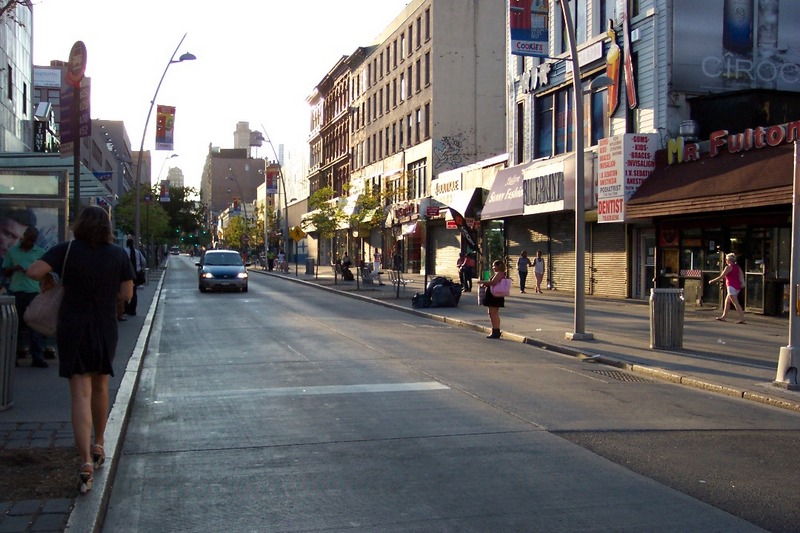 July, August 2012: Summer Walking Tours
July: Brooklyn's Fulton Mall; August: Roosevelt Island
The Air Quality Alert Summer of 2012 has arrived in NYC, and once again the traffic, smog and severely lowered quality of life for residents rich and poor, are as bad as ever. Yes, cars still pollute and run people over, and yes, the city is still doing everything possible to lure motorists into the city, despite all Mayor Bloomberg's expensive public relations campaigns about sustainability, some sprinkled bike lanes and corporatized ped malls for tourists. The Mayor's move this summer to outlaw Big Gulps - the supersize sugar drinks that are ruining people's health - is to be commended, yet the biggest 'gulp' of all, the unfettered use of motor vehicles in a crowded city, is all but ignored.
Maintaining our independent perspective about these facts of life here in NYC, Auto-Free NY this summer is venturing out -- "boots on the ground" and all that -- to actually visit our car-beleaguered city, and to see how lame City Hall is in doing anything substantive towards devehicularization and a more sustainable NYC. This summer's popular Walking Tours will visit Brooklyn's Fulton Mall in July, and Roosevelt Island in August:
JULY 24: Brooklyn's Fulton Mall: "Freshened" Up? But Still No Light Rail! It's been quite a while since Auto-Free NY last visited the Fulton Mall in Downtown Brooklyn. A few years ago, the pedestrian/bus-only mall on Fulton Street in Downtown Brooklyn received a mild makeover, with new lights, benches, plantings, signs etc. More of the irreplaceable historic cast iron buildings that gave the street so much character are being torn down, to make way for bland big boxes. But the mall's central character continues to resemble a concrete two-lane highway somewhere in Ohio, only less charming. And the city's law enforcers continue to look the other way, as numerous private cars penetrate this car-free space.
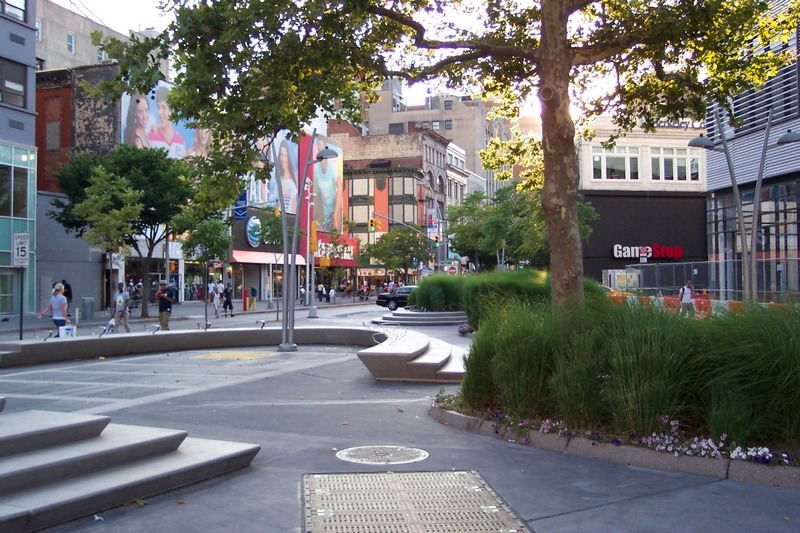 The good news is that there are still plenty of pedestrians who feel comfortable being at the Fulton Mall, Brooklyn's authentic "main street", and prefer to shop and people-watch here instead of going to the recently built (and heavily subsidized) nest of big-box stores just a few blocks south, at Atlantic Center. On the tour, plans for adding a modern streetcar/light rail line here will be reviewed, as will opportunities for expanding the NYU/Poly campus as an alternative to NYU's proposed massive expansion in the West Village.
Above right: View of Fulton Mall in downtown Brooklyn, looking west from Flatbush Avenue, summer 2012. Note private car on supposedly car-free mall, and bus stop at extreme left.
Lower right: This seating area at the eastern end of the Mall was reclaimed from the street by the recent mall makeover. [Photos: Wayne Fields]
AUGUST 28: Whos' Afraid of an Auto-Free Roosevelt Island? Roosevelt Island's narrow, two-lane medieval-feel "main street," originally conceived as the centerpiece of a car-free island, continues to be dominated by the tiny number of island residents who own cars. Though autos were to be corralled into a garage at the north end of the island, workers at the hospital at the island's south end demanded and got access to free (ie subsidized) parking space. Current plans by the permanent government call for this hospital to be demolished and replaced with a new technology campus, which to us looks like another pharaonic monument which will be an even greater generator of car trips, traffic, smog and parking garages. However, with a little imagination, one can envision new transit access, including a potential light rail line that would replace car lanes on the Queensboro (Koch) Bridge, that would cut car chaos. We will review AFNY's vision for light rail and pedestrian/bike access to the island from the Queensboro Bridge.
 Please note carefully the meeting points and times for these two tours. The tours are free, and will take place rain or shine. See you on July 24 and August 28!
June 2012: Getting TOD (Transit-Oriented Development) Right
Joint Meeting of AFNY and vision42; Special Guest: DAVID FIELDS
Long before the Bush/Cheney-era housing bubble burst around 2007, urban planners had been rethinking America's romance with endless outward metropolitan development, a trend made possible by over-dependence on free-wheeling motor vehicles for regional mobility. As cities across America have discovered, modern light rail transit can lure travelers out of their metal and plastic cocoons and convince them that an auto-free and more sustainable lifestyle can actually raise their quality of life. Now planners are also learning that new rail stations can also help to focus urban development in more people-friendly ways.
Among the leaders in rethinking the shape of our cities is the firm of Nelson/Nygaard, at which our June speaker, David Fields, is a principal. Plan to attend our next Auto-Free NY/vision42 working group meeting to hear more about the shape of cities to come. This special meeting will be co-sponsored by the American Planning Association Metro Chapter's Transportation Committee.
(Please note that because of the larger expected attendance, the meeting will not be at the TA office but instead will be held at the nearby Van Alen Institute, 30 West 22nd St., 6th Floor, NYC. Although not required, an RSVP is strongly recommended, at info@vision42.org.) Also coming up this summer will be our popular walking tours, scheduled for mid-July and mid-August. Stay tuned for details!
May 2012: The Tappan Zee Bridge: Which Way Forward?
Joint Meeting of AFNY and vision42; Special Guest: FLOYD LAPP
Governor Andrew Cuomo's top 2012 transportation project is fixing the Tappan Zee Bridge. The current plan being pushed by the state and the mainstream media is a new bridge with no transit, and 8 wider lanes replacing the current 7 narrow lanes . . .
The projected cost of this replacement bridge is "north" of five billion dollars. It seems unlikely at this time that motorists will pay even a third of that cost through higher tolls. At our May Auto-Free NY/vision42 working group meeting, our guest speaker will be Floyd Lapp, a transportation planning expert long known in NYC. Mr. Lapp will lead a discussion on the merits of this project and about the difficulty of advancing worthwhile "mega-projects" in the NY-NJ-CT region. Floyd was director of the Transportation Division at the NYC Department of City Planning, and is a member of the vision42 Advisory Committee.
Following the discussion there will be updates on the vision42 initiative for an auto-free light rail boulevard on 42nd Street and other efforts to reduce car overuse in the crowded core of our city. Plan to attend - it should be an interesting evening. An RSVP is not necessary to attend, but is recommended - send to info@vision42.org.
Also - don't miss National Train Day, this year at Grand Central Terminal's Vanderbilt Hall on Saturday, May 12, from 11am-4pm. This free event will feature tours of vintage and modern train equipment, a Kids Depot for children, model train display and live entertainment. [See the National Train Day website for details.]
April 2012: Roads to Rails: The Queensboro Bridge: Putting People on Top
Joint Meeting of AFNY and vision42
Discussion of IRUM's plan to restore light rail service on the Queensboro Bridge's lower deck outer roadways and remaking the upper deck into a promenade for pedestrians and a bike route for cyclists.
March 2012: Roads to Rails: Second Avenue in Manhattan
Joint Meeting of AFNY and vision42
For our March 20 meeting, AFNY and the vision42 working group continue their monthly dialogue on practical ways to reduce our crowded city's overindulgence in motor-vehicular surface transportation. While an auto-free light rail boulevard on 42nd Street, river-to-river, remains our top priority, we hope to broaden our constituency by highlighting the many opportunities for re-purposing NYC's public thoroughfares from an emphasis on moving motor vehicles to a location for surface light rail transit and pedestrian amenities.
At the beginning of the 20th century, Manhattan's renowned grid of crowded streets hosted the world's most extensive network of street railways (or "trams" as they are affectionately called in Europe). Barely fifty years later, this extraordinarily rider-friendly means of urban transport -- and considerable public investment -- had been dismantled by a coalition of ill-advised "progressives," misled and prodded on by powerful auto industry interests. Tracks were removed and surfaces were repaved to satisfy the auto's insatiable appetite for more road space.
The so-called 'solution' became the problem as streets, bridges and tunnels quickly filled with private cars, traffic slowed to a crawl, pedestrians found it more difficult than ever to cross streets and travel by bus became the mode of last resort.
But this sorry situation is reversible. No bus route in the entire US is busier than the MTA's M15 First and Second Avenue line. While MTA and NYC's Department of Transportation have made a noble first step in remaking the buses running in "limited" service on this line into a "Select Bus Service," there is a long way to go to transform Manhattan's East Side into a livable urban place.
At our March meeting we will revisit a plan for light rail on the East Side developed by Philipp Rode, a graduate student from Berlin Technical University who did an internship at the Institute for Rational Urban Mobility, Inc. (IRUM) over a decade ago. [Mr. Rode's thesis is posted on IRUM's website: www.irum.org.] We will also review the current performance of the M15 Select Bus Service and the ongoing construction nightmare of the 2nd Avenue Subway. Please plan to attend. Note that our meetings now return to the TA conference room, 127 West 26th Street, NYC.
February 2012: Latest Developments in Streetcars: Kinkisharyo Trams
Joint Meeting of AFNY and vision42
Special Guest: Representative from Kinkishariyo
After more than eight years in office, Mayor Mike Bloomberg has recently made some modest first steps in "de-vehicularizing" the city, such as installing pedestrianized spaces in Herald Square and Times Square, and adding miles of physically separated new bike lanes, for example Eighth Avenue from Greenwich Village to 23rd Street. But the Mayor still apparently considers even the thought of LRT in his city radioactive, preferring to fiddle with painted bus lanes in a few streets.
While Bloomberg dithers, dozens of more sophisticated and democratically run cities around the world have been rushing to complete new installations of this city-friendly urban transport mode. Not only that, but they have been quick to adopt the latest innovations in light rail vehicles and equipment, meaning that NYC is falling even further behind in investing in its surface transit.
Cars still rule supreme in Mayor Bloomberg's worldview, even though the majority of citizens of his city do not own cars, yet suffer lower quality of life because of them. This so-called "windshield perspective" also rules in the city's mainstream media, which maintains a cloak of economic censorship over transit advances in more sophisticated cities throughout the world.
To help clarify New Yorkers' vision of the latest thinking in new design streetcars, Auto-Free NY last fall invited representatives of three of the world's largest railcar manufacturers to each make presentations on their latest tramcar product lines, particularly those that would be suitable for the long proposed 42nd Street light rail line. New Yorkers should have the right to know about the remarkable innovations worldwide that are taking place in new LRT equipment.
For our February meeting, it will be Kinkishariyo International's turn to talk about their latest equipment, in particular "wireless" streetcars - electric vehicles that do not require overhead catenary wire. Please come by the TA office to see these fascinating new developments. Also, cross the Hudson River and take a ride on the Hudson-Bergen LRT line (which uses Kinkishariyo cars, by the way!), to see for yourself what modern trolleys are really like.
January 2012: Planning for a Design Charette for 42nd Street LRT - First to Second Avenue Block
Joint Meeting of AFNY and vision42
Special Guest: Ed Walters, photographer
Our January meeting was held jointly with vision42 at the spacious offices of the Open Space Institute, just north of Herald Square. The meeting was a workshop to briefly sketch design elements for an auto-free light boulevard on 42nd Street, focused on a single block - between 1st and 2nd avenues. The idea is that a design charette involving planners, residents, building owners and the public would gather to hash out what kind of street they would like it to become, presuming an LRT crosstown line is installed. Ed Walters presented a fine and comprehensive set of photos of the block as it looks now, including views of the UN, Tudor City and the Ford Foundation.
October, November, December 2011
Presentations by Manufacturers of Advances in Modern Light Rail Vehicles
Back on September 8, in a televised speech, President Obama laid out a strong vision of a credible national jobs program, calling for immediate federal investments that included numerous key infrastructure projects. [In case you missed this speech, we urge you to visit whitehouse.gov for the unadulterated version.] At seven minutes into the 32-minute speech, as the President discusses how infrastructure projects, in particular transit and light rail, can relieve chronic traffic congestion, a remarkable image appears on a sidepanel, of the Houston Metrorail light rail system (LRT).
In today's cars-only corporate media climate, it's not often that the President of the US appears with an image of a modern light rail vehicle, and certainly not in prime time. But that's even less so with NYC's Mayor Mike Bloomberg, who apparently considers even the thought of LRT in his city radioactive. While Bloomberg dithers, dozens of more sophisticated and democratically run cities around the world have been rushing to complete new installations of this city-friendly urban transport mode. Should our billionaire Mayor ever take his private jet to Zurich some weekend, perhaps taking a sample ride on one of Zurich's new fleet of modern tram cars that are the pride and joy of this eco-friendly Swiss city could help him overcome his distaste for LRT.
Modern streetcars in today's advanced cities provide a double incentive -- the proverbial "carrot and stick" -- for motorists to get out of their cars. The "carrot" consists of quiet, clean and people-friendly surface transport, while the "stick" is the taking away of some roadspace that would otherwise be pre-empted by automobiles, most of which each carry only one person, the driver.
To help clarify New Yorkers' vision of the latest thinking in new design streetcars, Auto-Free NY has this fall invited representatives of three of the world's largest railcar manufacturers to each make presentations on their latest tramcar product lines, particularly those that would be suitable for the long proposed 42nd Street light rail line. New Yorkers should have the right to know about the remarkable innovations worldwide that are taking place in new LRT equipment. You are cordiallly invited to attend these free presentations, to be held at the Van Alen Institute, at 30 West 22nd St., 6th Floor:
Tuesday, Oct 25, 2011 6-8pm -- Bombardier
Tuesday, Nov 15, 2011 6-8pm -- Siemens
Tuesday, Dec 20, 2011 6-8pm -- Alstom.
September 2011: Finessing the 34th-42nd Street LRT Loop Proposal
[The September Auto-Free NY meeting was run jointly with the vision42 working group.] The discussion of design options for the 34th Street segment of the 34th Street/42nd Street light rail loop will continue. New input from our two summer walking tours, held in July and August, will be considered. Both tours were well attended and a number of ideas came up.
Also, plans for relocation of the blacktop portion of Robert Moses Park at 42nd Street and First Avenue, now being advanced by East Side elected officials, will be discussed. The vision42 plan for an auto-free light boulevard on 42nd Street could be an important element of this discussion.
As a special treat, Olympia Kazi, Executive Director of the Van Alen Institute, will describe the Institute's 2010 competition, "Life at the Speed of Rail", as well as the components and complexities of putting together a design competition. This could be useful for vision42. [Time permitting, an updated version of "a light rail grid for Manhattan", first shown at the Dec 14, 2010 meeting, will be presented.]
July and August 2011: Summer Walking Tours - Miracle [Light Rail] on 34th Street
At every major bridge and tunnel in NYC, you can see the many motorists driving private cars solo into Manhattan who haven't gotten the message that the bike lane program has solved all of our city's traffic problems. For the summer of 2011, with NYC once again mired in the worst smog on the East Coast, thanks mostly to too many cars, Auto-Free NY is going to revisit 34th Street in midtown -- the city's crossroads of commerce and transit -- in order to take a close look at light rail for this key corridor.
Early in 2011, the NYC Dept of Transportation's modest plan to close part of 34th Street to private cars was run over and crushed by defenders of car privileges in midtown. Lost in this latest battle over street space, which involved a "nominal" bus lane, was the bigger picture about the imbalance of motor vehicles on our streets. If we examine the 45 crosstown streets between 14th Street and Central Park in midtown Manhattan, only 42nd Street hosts more pedestrians per square foot than 34th Street. Yet the timid city DOT could only muster enough courage to suggest closing a single block of 34th Street to vehicular traffic -- between 5th Avenue and 6th Avenue.
It seems city officials, peering thru the windshields of their company cars, or past the lapels of taxi industry lobbyists, didn't notice the huge crowds trying to get to Macy's (the self-proclaimed world's largest store) or to Penn Station -- the nation's busiest railway station. Nor did they acknowledge all the pedestrians [and potential shoppers] who stay away because of the unpleasantly crowded sidewalks and traffic noise and smog. Rather than boldly calling for all three blocks between 5th and 8th avenues to become auto-free, instead the NYC DOT retreated and now is half-heartedly struggling to splash on some terracotta-colored pavement in a feeble attempt to speed crosstown bus travel. [Memo to real New Yorkers: it's still quicker to walk!]
Perhaps it is time for our jetsetting billionaire Mayor Bloomberg - who travels to one of his estates in Bermuda almost every weekend, to invite some of his NYC DOT officials to climb aboard his personal jet and junket them to Vienna or Budapest and see how real grown-up cities treat their urban cores -- with auto-free streets and modern light rail lines.
Find out how 34th Street can be miraculously remade - and not just for the benefit of merchants! Vision42 has a remarkable plan for a midtown surface light rail loop that would utilize 34th Street. Join us for our next two AFNY walking tours on Tuesday, July 26, and Tuesday, August 23 -- both days from 6-8pm. Both tours will begin in the center of the pedestrianized plaza at the front door of Macy's on Broadway, between 34th Street and 35th Street, promptly at 6pm - rain or shine. The JULY tour went east to the East River; the AUGUST tour headed west to the Hudson River. Both tours are FREE, take place rain or shine, and there is no need to RSVP. See you there!
June 2011: 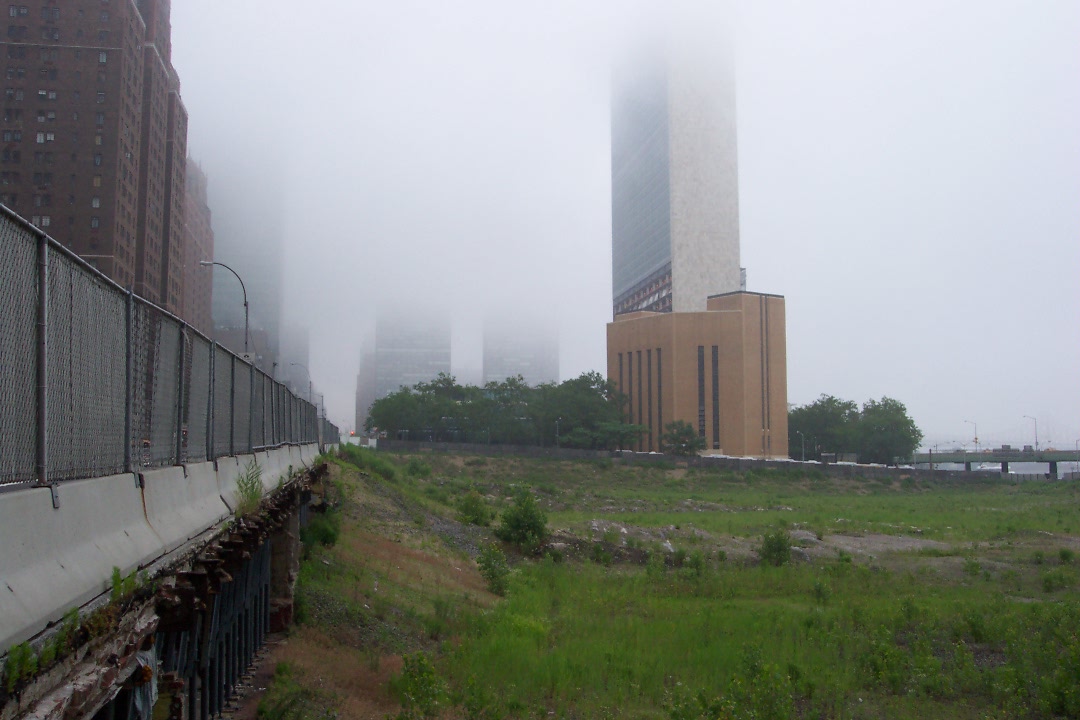 Threading Light Rail Thru Midtown East
Several years ago NYC rezoned a key segment of the East River waterfront just south of the UN's headquarters, from 35th to 41st streets. This bonanza from our government allowed the developers to quickly demolish the sturdy and historically relevant 1906 Waterside electric generating plant in 2008, creating the current fenced-off and barb-wired riverfront prairie along First Avenue, from 38th to 41st streets, pictured at right (shown: June 2011 view looking north from 38th Street, with UN building in the background, and Tudor City at left). In this space, the unstoppable developers, the Solow company, will soon shoehorn in a massive wall of luxury residential and office towers. Some 5,000 new high-rise housing units will be added to an area that is at least a half mile walk from the nearest (and already severely overcrowded) subway line, at Lexington Avenue.
As for the long-promised Second Avenue subway line, it will not reach this part of midtown for at least 20 to 30 years! It is currently being built from 63rd to 96th St., and many years from now, when that's done, the next segment to be funded -- IF funding can be found -- will be from 96th to 125th Street - add another decade or so. That leaves buses.
But get this - no new bus service is planned! In fact, against strong community opposition, the MTA recently discontinued the M104 crosstown 42nd Street bus. Not to worry -- Mayor Bloomberg has thoughtfully allowed developers to add a whopping 1,200 new parking spaces so that the tower's luxury apartment dwellers can store their luxury 4-WD racing vehicles - and continue avoiding public transportation.
Our billionaire Mayor, ever busy networking with global environmental leaders, and also hoodwinking the environmental community with his 2030 sustainability plan, has unfortunately been busy inking deals (or at least looking the other way) as a wave of cars-preferred big-box stores and developments such as this new East midtown plan, with huge parking garages above or below ground, engulf the City. Bloomberg's environmental legacy, other than a lot of new trees, will be ever more car chaos, as the common on-the-ground experience for East Midtown residents, workers and visitors.
It doesn't have to be this way. Come to our next AFNY meeting this June 28. Our guest speaker John West, a board member of IRUM, and a member of Community Board 6, will describe how a more sophisticated city would create a genuine urban fabric in Midtown East, and invest in significant public transportation, in particular a modern light rail line, that could be threaded through this area. Please take note that this June meeting will be held at the Van Alen Institute, at 30 W 22nd Street, not at the TA office. It will be a joint meeting with vision42. Hope to see you there!
May 2011: New Book: "Stop Signs: Cars and Capitalism on the Road
to Economic, Social and Ecological Decay"
Special Guests: Yves Engler, author and Montreal political activist; and Bianca Mugyenyi, Concordia University
Our May AFNY meeting will feature two special guests from Montreal: Yves Engler, author and political activist, and Bianca Mugyenyi, campaign coordinator at Concordia University's Centre for Gender Advocacy. They will be unveiling and discussing their newly published book "Stop Signs: Cars and Capitalism on the Road to Economic, Social and Ecological Decay."
Please plan to attend our meeting this month as we learn their perspective on the automobile crisis. The meeting, to be held at the TA office on West 26th Street, is free and there is no need to RSVP.
April 2011: The Mayor's Updated Sustainability Plan: Would PlaNYC 2.0 Reduce Car Use?
Panelists: IRUM board members Jeff Gold, Jill Greenberg and George Haikalis
Almost four years after Mayor Bloomberg's Office of Long Term Planning and Sustainability released the first plaNYC, it has now produced an updated plan - plaNYC 2.0. The original 2007 plan floated a raft of suggestions that would take take hold no later than 2030 - even while the City continued incentivizing private car commuting, and was in the midst of an aggressive parking garage/shopping mall construction spree, that would serve to lock in more private car usage.
Almost all of the press attention on the first plan focused on one strategy -- congestion pricing. We know what happened to that strategy. On the other hand, the plan called for the creation of a handful of midtown pedestrian plazas, mostly along Broadway, and there is no doubt that the Times Square and Herald Square plazas are very popular, particularly with tourists, shoppers and the merchants that line these plazas.
Join us at our next Auto-Free New York meeting to learn what's contained in the new plan, and see how its transportation strategies compare with those contained in Auto-Free New York's longstanding, comprehensive
Livable City Transport Plan - which itself has gone through several upgrades already.
March 2011: Rail Access to the Region's Airports: Where We've Been, Where We're Headed
Special Guest: Anthony Callendar, transportation planner; former senior staff analyst, Aviation Dept., Port Authority
Most airports in the US are heavily dependent on parking revenues for operating and capital costs. As a result, airport authorities have, over the decades, for the most part, fought against extension of rail systems to serve growing travel demand. Nowhere has this been more pronounced than here in the NY metropolitan area - the nation's most rail transit-oriented city!
Eventually forced to respond to growing public pressure, worldwide ridicule, enlightened politicians, and just plain common sense, NYC eventually built rail connections at JFK and Newark Liberty Airports, but these require inconvenient transfers, and fares have been set very high. No rail link is available to LaGuardia Airport, although it is less than two miles from the last stop of the N and W train in Astoria.
The result, not surprisingly, is ongoing endless automobile traffic and taxi dominance for travel to airports, with resulting congestion and pollution, as well as disincentives for tourists.
Plan to attend our next Auto-Free NY meeting, where we will hear from Anthony Callendar, a transportation planner formerly at the Port Authority, on how we got into this situation and how we can do better.
February 2011: The Case for Light Rail in NYC
Special Guest: Paul Gawkowski, Transportation Planner; former director, NYC Transit Operations Planning, Bklyn & Queens Surface Transit
For our February 2011 meeting, we continue our series of advocating for the return of streetcars and modern light rail to NYC. We are lucky to have as guest recently retired transit professional Paul Gawkowski, who has been in the trenches for many years trying to make surface transit work better in Brooklyn and Queens.
Mr. Gawkowski, sharing with us his years of hands-on experience in transit, will treat us to a special audio-visual presentation offering his ideas on reintroducing street railways in NYC, once a world capital for this mode of urban travel.
Our February meeting will be held in conjunction with the regular monthly meeting of vision42 -- an initiative to advance an auto-free light rail boulevard on 42nd Street.
January 2011: Light Rail for Stamford and New Haven: Why not in NYC?
Special Guest: Stephen Gazillo, director of transportation planning, URS Corporation
Some three dozen American cities, and countless other cities throughout the world, have added new light rail/streetcar lines to provide attractive alternatives to motor vehicular travel. Replacing pavement on urban
streets with modern, low-floor streetcar and light rail tracks is a surefire way to combine the 'carrot' of better transit with the 'stick' of disincentives to drive in dense urban places.
Even Los Angeles - "car central" - will be adding over the next ten years about 41 miles of new LRT and subway tracks to its existing 79-mile system. But NYC remains mired in traffic chaos, transit bureaucracy paralysis and cost overruns. Look at New Jersey! New light rail lines have been operating less than a mile away from Manhattan, directly across the river in Jersey City and Hoboken. In fact, the Hudson-Bergen light rail line on the waterfront can easily be seen in operation from New York, including from the windows of the editorial offices of the NY Times' skyscraper on Eighth Avenue! Now two nearby cities in Connecticut - Stamford, and New Haven - are planning new lines.
Our special guest this meeting was Stephen A. Gazillo, director of transportation planning at URS Corporation. Gazillo gave us an overview of planning efforts for new light rail/streetcar lines for Stamford and New Haven, CT and extensions to the existing line in Charlotte, North Carolina.
In addition, progress reports on the vision42 plan for an auto-free light rail boulevard on 42nd Street, and NYCDOT's planning study for a trolley linking Red Hook with Downtown Brooklyn, were made.
© Copyright 2019, 2020. All rights reserved. Auto-Free New York.
|